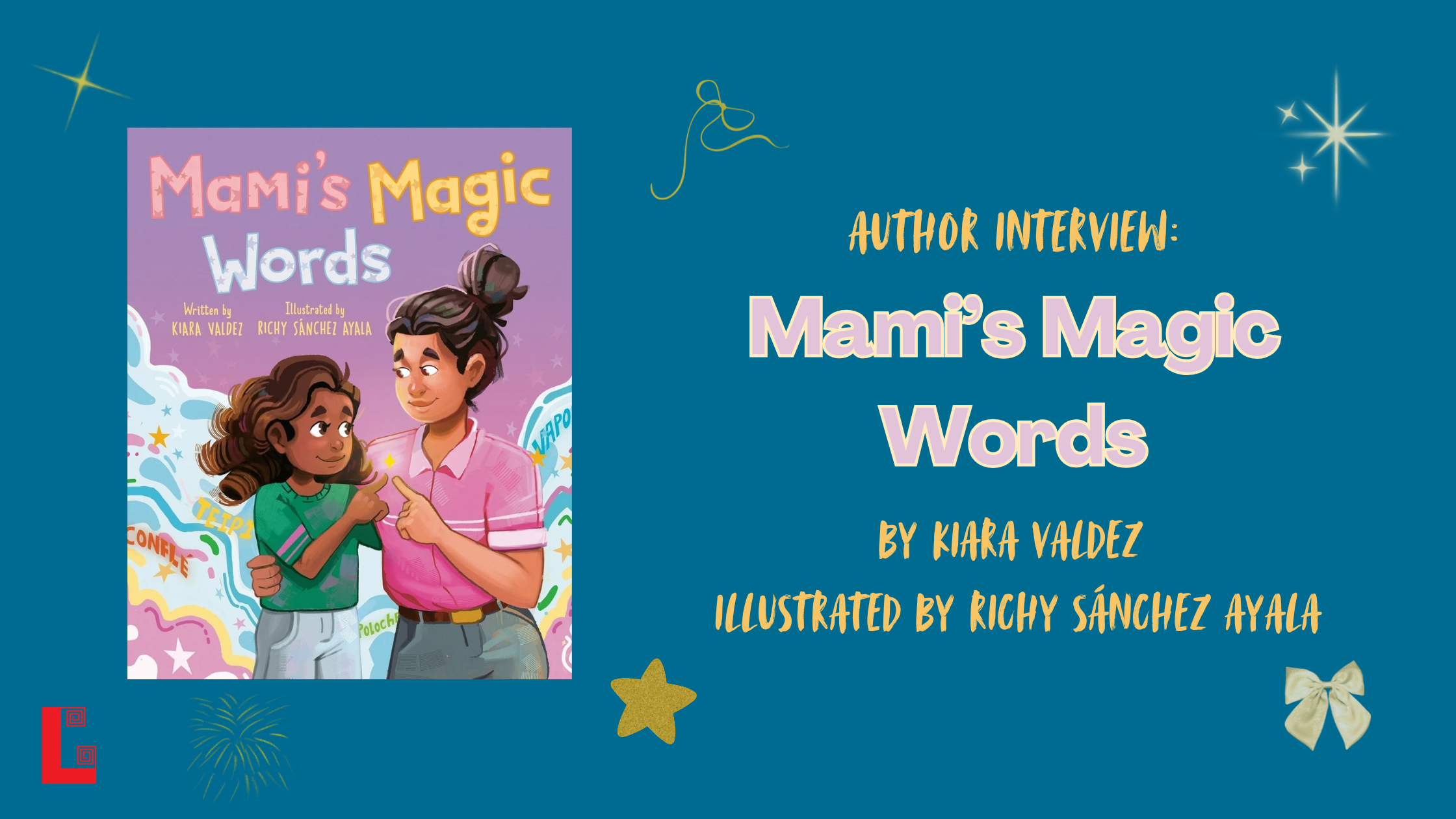
Author Kiara Valdez’s picture book, Mami’s Magic Words, leads with the power of words, and how our everyday conversations can have a deep impact on an individual. This story has beautiful language that for some people might feel like home, such as “conflé.” Young readers will connect together as they hear words they might be familiar with, while adult readers will be transported back to when they first learned a word.
YVONNE TAPIA: Welcome Kiara! It’s great to have you here; your story made me feel seen and love how it speaks on the importance of words, especially from family. How did you decide to write about this topic?
KIARA VALDEZ: Thank you Yvonne! That means a lot. I actually had a similar experience to the story when I took an official Spanish class in school. For fun I decided to take a 200-level Spanish class because I wanted an easy-grade. There was a moment when the class was talking, I don’t remember the actual topic, and in the conversation I said the Dominican Spanish version of “messy.” My teacher didn’t know the word and he asked, “What do you mean? Like organizing something?” and while it wasn’t super mean on his part he seemed to have a condescending [tone and expression]. That had such a profound impact on me, and it’s when and where I started thinking about languages, dialects, and similar in Spanish.
Once I started wanting to write a picture book, this is the topic I really wanted to talk about, because from that moment on in high school, I [noticed] how much I loved the Dominican dialect, and learned [little by little] how there are different dialects and it also depends on where you go and who you’re talking to. I’ve always been a language learner and a lover of language.
I wanted to do a kind of homage to the Dominican accent with this perfect picture book.
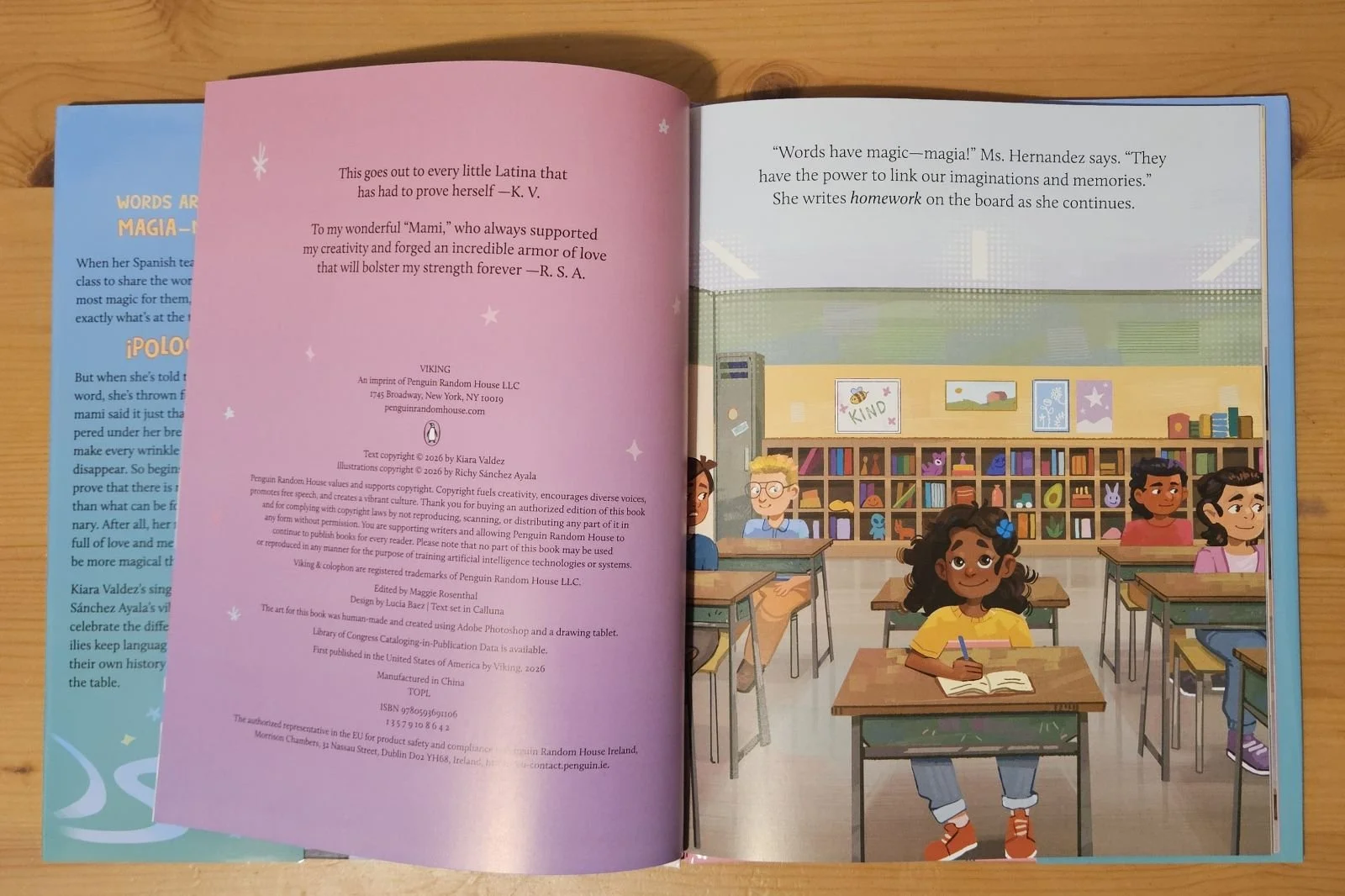
Photo credit: Yvonne Tapia
YVONNE TAPIA: So powerful, and I relate. Growing up I would find myself in situations where I would say a word or expression that I learned from my mom or other loved one and, sometimes someone would ask me to clarify. Translating Spanish slang to standard Spanish or from Spanish to English was different. When I got asked to clarify by another fellow Latino, that had me learn that even among Spanish-speaking countries there are differences in each country’s Spanish- language slang.
KIARA VALDEZ: Exactly. As I got older, I realized that even having accents, [in my case the Dominican accent] was its own type of special.
“ Magic is the everyday. It’s a feeling, a curiosity. It’s a kind of warmth that reminds you you’re alive and that you’re human. There are so many things that can hold [magic], like words.”
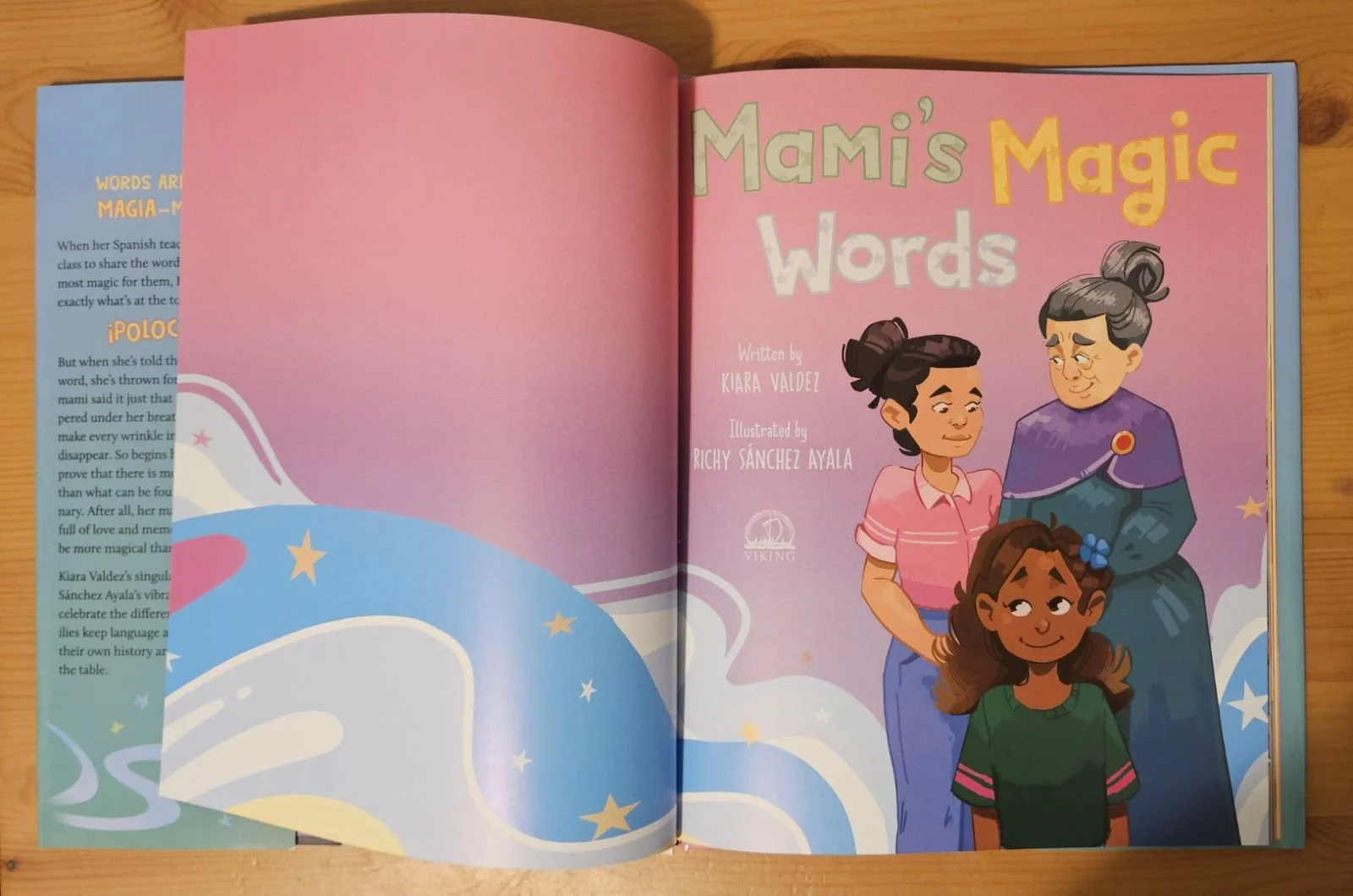
Photo credit: Yvonne Tapia
YVONNE TAPIA: Absolutely. How did you connect with your illustrator to make this story come to life?
KIARA VALDEZ: Through my agent and our wonderful editor, Maggie, at Viking. [She] really saw the vision. At first, this picture book [had its difficulties]; we had a lot of “no’s.” For a hot second there, I thought this book would not exist. But someone amazing at Viking found and understood the vision [for this picture book] and we went from there.
YVONNE TAPIA: That’s great and it makes a huge difference. Your story shows that words can connect and hold a magic of their own. What does magic mean to you in this context? How do you come across it every day?
KIARA VALDEZ: Yes! Magic is the everyday. It’s a feeling, a curiosity. It’s a kind of warmth that reminds you you’re alive and that you’re human. There are so many things that can hold [magic], like words.
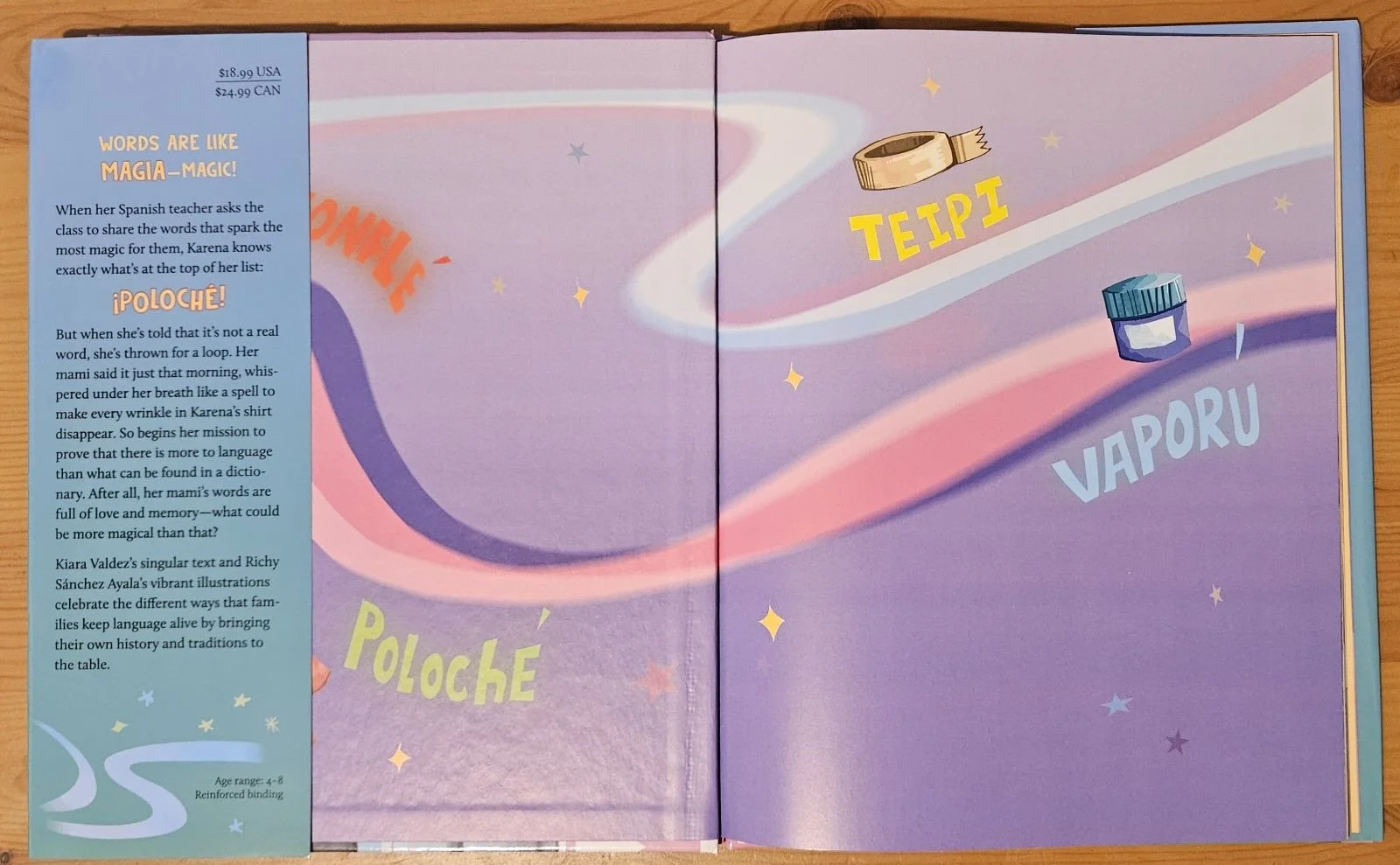
Photo credit: Yvonne Tapia
YVONNE TAPIA: Definitely, woo!
KIARA VALDEZ: I’ve been an avid reader since I was a kid; words, stories, the library. They held a lot of comfort for me and that, for me, was magic. The Dominican accent, music with its own words and melody, that’s all magic for me. Those interactions remind us that we are live, and there’s a reason to wake up the next day. I wanted to bring that feeling together [through this story].
YVONNE TAPIA: This also ties in with how we honor the words and customs our ancestors used; from how we express ourselves to how we interact with each other.
KIARA VALDEZ: Yes, 100%!
YVONNE TAPIA: How did you establish the story’s setting?
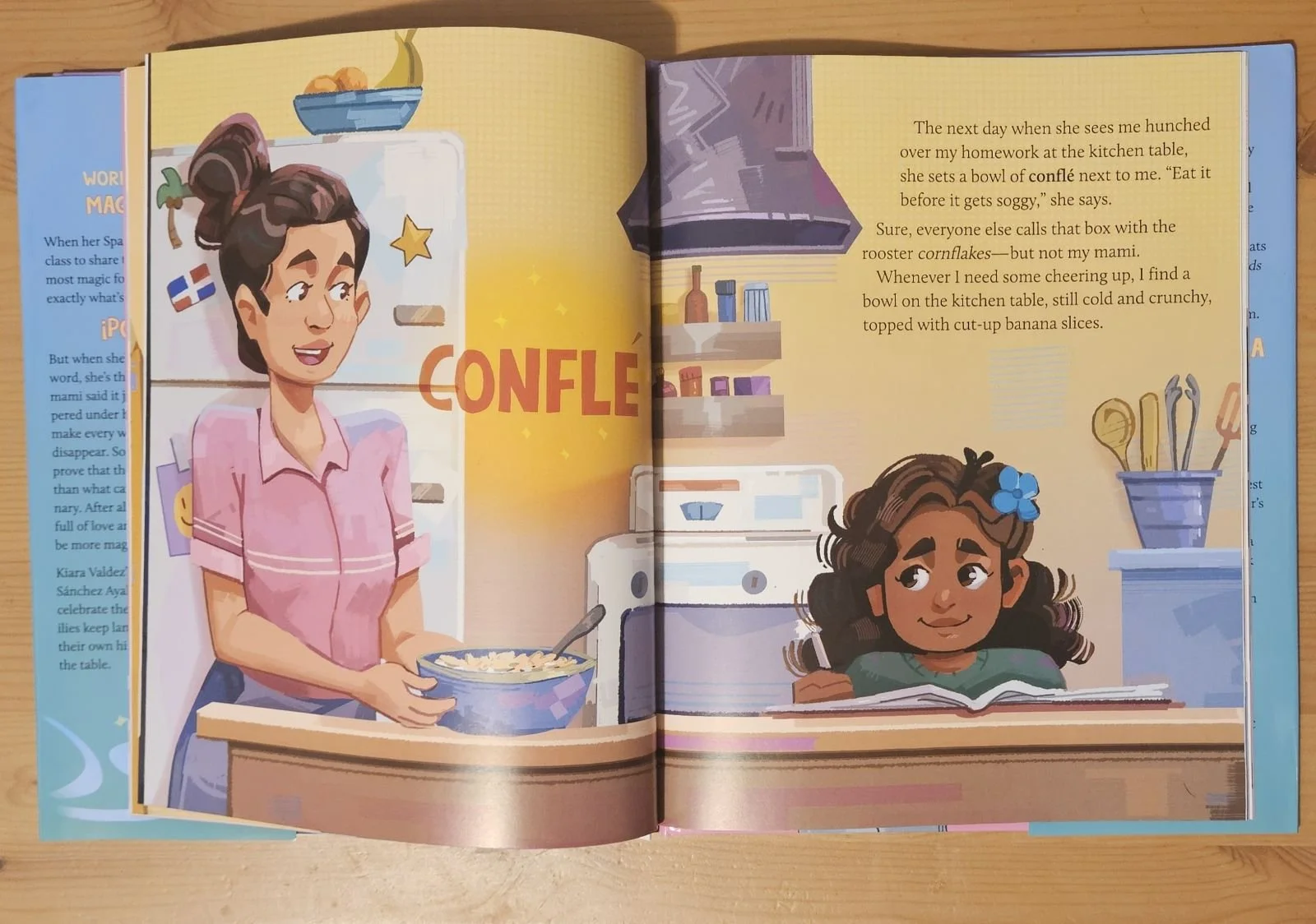
Photo credit: Yvonne Tapia
KIARA VALDEZ: I was debating whether to have it outside the classroom setting, and then I remembered my own past experience. In a classroom, in this case a language class, teachers are meant to be the experts of the language. When Karena was questioned about her language by “an authority figure of the language,” that’s when the theme of this story really kicks off. The whole theme, like the Dominican dialect and generally my [opinion] about accents, are fighting the official quote-unquote language established in the classroom. The teacher starts off as a bit antagonistic, and then even the teacher’s character develops, which I [enjoyed writing]. Everyone can question everything.
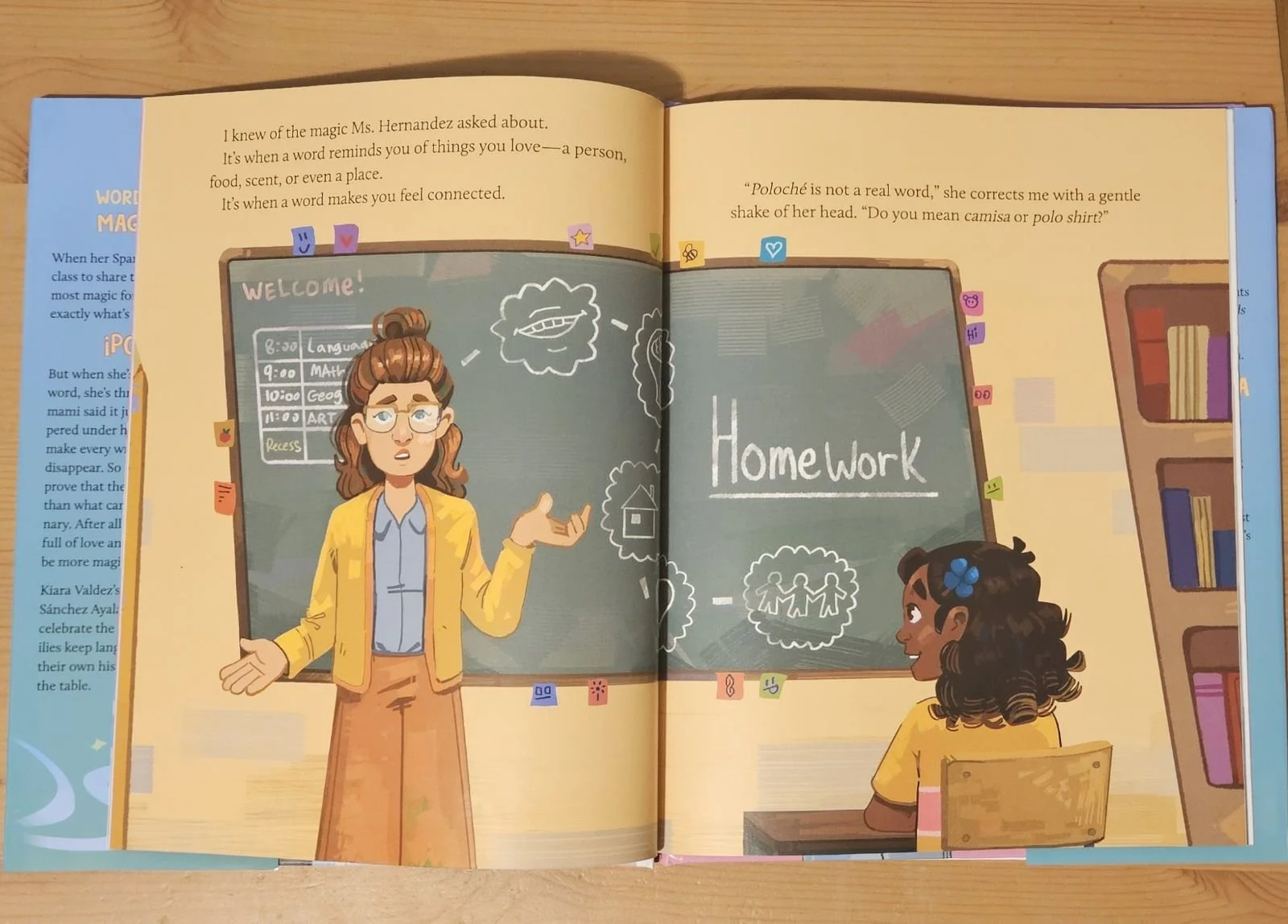
Photo credit: Yvonne Tapia
YVONNE TAPIA: Yes, taking ownership of that! This goes back to the theme of who owns the story, how the story is told, who listens to it, etc. In this example, one person’s home experience can be very different from another’s, and that’s exactly what we see from Karena, who grew up on Dominican vocabulary from her mother whereas her classmates didn’t. Each cultural heritage has their own vocabulary. Like you said, it’s good practice to question everything.
KIARA VALDEZ: I love that. Karena is a very inquisitive child, and I think that’s a great habit for kids to have.
YVONNE TAPIA: What challenges did you face when writing about linguistic identity to young readers? This is a very powerful topic to convert into a picture book.
KIARA VALDEZ: That was the biggest difficulty, and following that was getting this book acquired. Some editors my agent and I submitted this story to said, “this should be a chapter book” or “this can’t be a picture book because it’s too complex.” I stated this can be a picture book as it can have different layers. A kid will read it and understand some layers, while a parent-figure or other adult will understand the story fully and see the extra layers. Then when the kid grows older, and they read the story again, they’ll [understand] a new layer. As an older individual you can see the complexities of the linguistic part of the story.
This is a story about having pride in the language you’re taught at home. I think that’s something any kid can walk away with very happily. This is a celebration of words. Celebrating the difference between Spanish dialects and similar. Readers can also walk away with thinking deeper about the idea of borrowing language from each other. For instance, how English and Spanish were the languages most exchanged [in the world].
YVONNE TAPIA: That ties in with how classroom settings establish language as well.
KIARA VALDEZ: Yes, like who decided what the standard of language is? It’s something to think about. It should be more custom to accept that accents exist and it’s beautiful if a person has or does not have an accent. It’s also important to remember the exchange of language. While we use the word “chancleta,” others might use “chancla” and that’s beautiful.
You can also start wondering and searching for reasons to things like why Dominicans cut all of their “S’s”, which is for phonetic reasons. It’s part of a system we built as people and depending on the region each lives in.
YVONNE TAPIA: Absolutely, each person learned to speak a language based on where and how they grew up. In Karena’s story, you bring to readers words like “poloché” and “conflé.” If you know you know, readers.
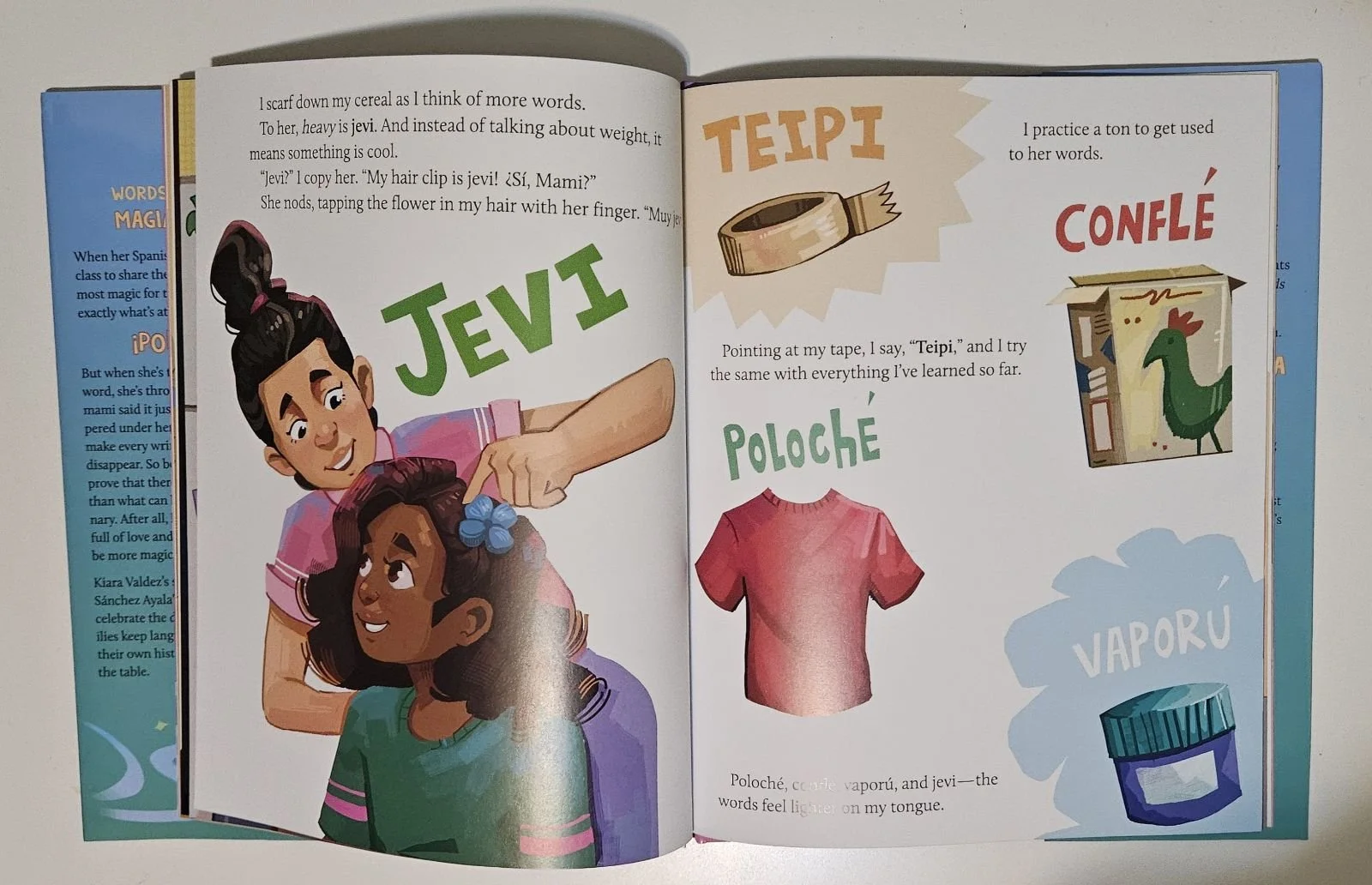
Photo credit: Yvonne Tapia
KIARA VALDEZ: Haha, “poloché” originates from “polo shirt,” and this relates to the concept of how words are sometimes borrowed to be adapted in another language and/or culture. There could’ve been a previous non-anglicized version of the word, and that’s why it’s wonderful to invite all languages as they each hold history based on interactions.
As I continued my schooling, I learned that [there are people] that consider the Dominican accent to be “lower tier,” as in very ghetto. So I want to make sure kids who are not growing up in a majority Dominican neighborhood, especially now, that youth and [adults] don’t experience what happened to me and they feel confident and embrace their language from the very beginning.
We’re blessed with people like Bad Bunny as he performed in the Bunny Bowl. There may be instances where we don’t fully understand some lyrics but he’s developed a culture of appreciating an accent, and I’d love for my book to follow suit. Just think about the magic of words. Think about how beautiful our accents are. When I went to school, sometimes I would find myself missing our accents. It’s like its own onomatopoeia.
YVONNE TAPIA: I too grew up hearing different accents. What would you like for readers to take away with this story?
KIARA VALDEZ: I’d like for adults to be more careful with how they address language with kids. *spoiler alert* By the end of the story, there is even an adult who realizes even she has changed up her home vocabulary. She becomes introspective about why she makes the decisions she makes when it comes to Spanish-language. So that in turn is her own story.
I really encourage Spanish teachers to bring their cultural point-of-view and even include discussions about accents sometimes. For parents, to have conversations about language with your kids and grow from there.
For more updates from her recent works, follow author Kiara Valdez on:
Website: https://kiaravaldez.com/
Instagram: https://www.instagram.com/dezinpub/
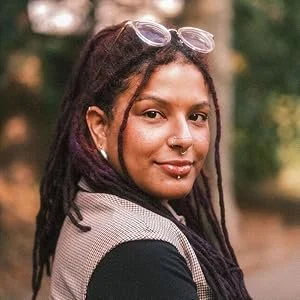
Kiara Valdez is an Afro-Dominican writer and graphic novel editor from New York City (shout out to Washington Heights). She graduated from Williams College with a double major in English Literature and Japanese, and spends her free time reading, writing, and enjoying a long list of other hobbies she can't keep up with. She writes graphic novels, pictures books, and story books that include titles such as Dear Dad (with Jay Jay Paeon and Markia Jenai, Marvel's Liele Groot), Big Feelings and We Are Groot (both with Wendy Tan), Mami's Magic Words (with Richy Sánchez Ayala), and Stepping Up (with Diana Tsai Santos).
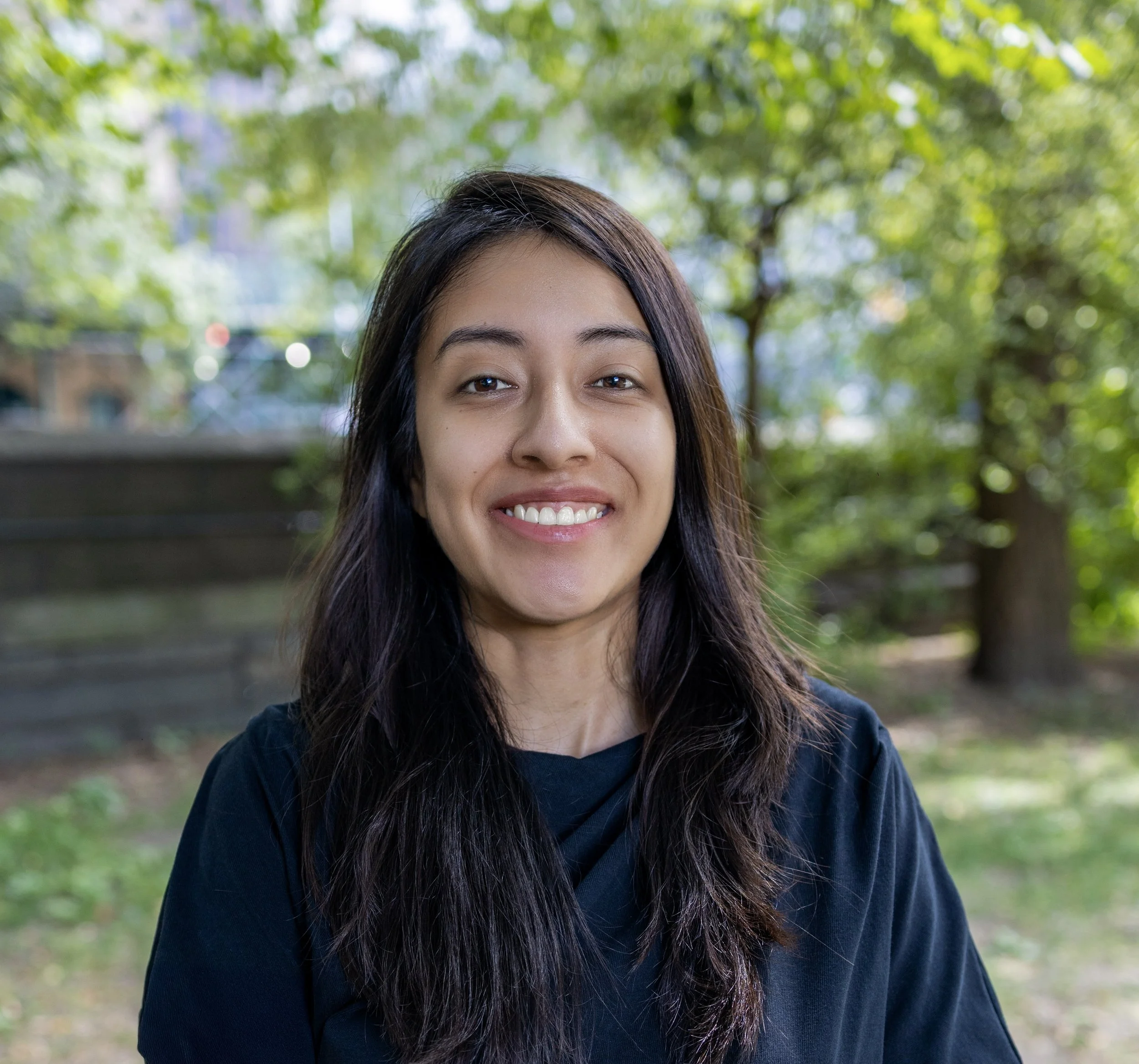
Mexican-American professional Yvonne Tapia has an extensive background in marketing, education, and media, supporting both large enterprises and small businesses. Yvonne focuses on raising brand visibility and community engagement, particularly within marginalized sectors. She currently serves as a Senior Instructor at COOP Careers, where she mentors through hands-on marketing training while partnering with businesses from different industries. Outside of work, Yvonne is an avid reader and is involved in supportive causes.