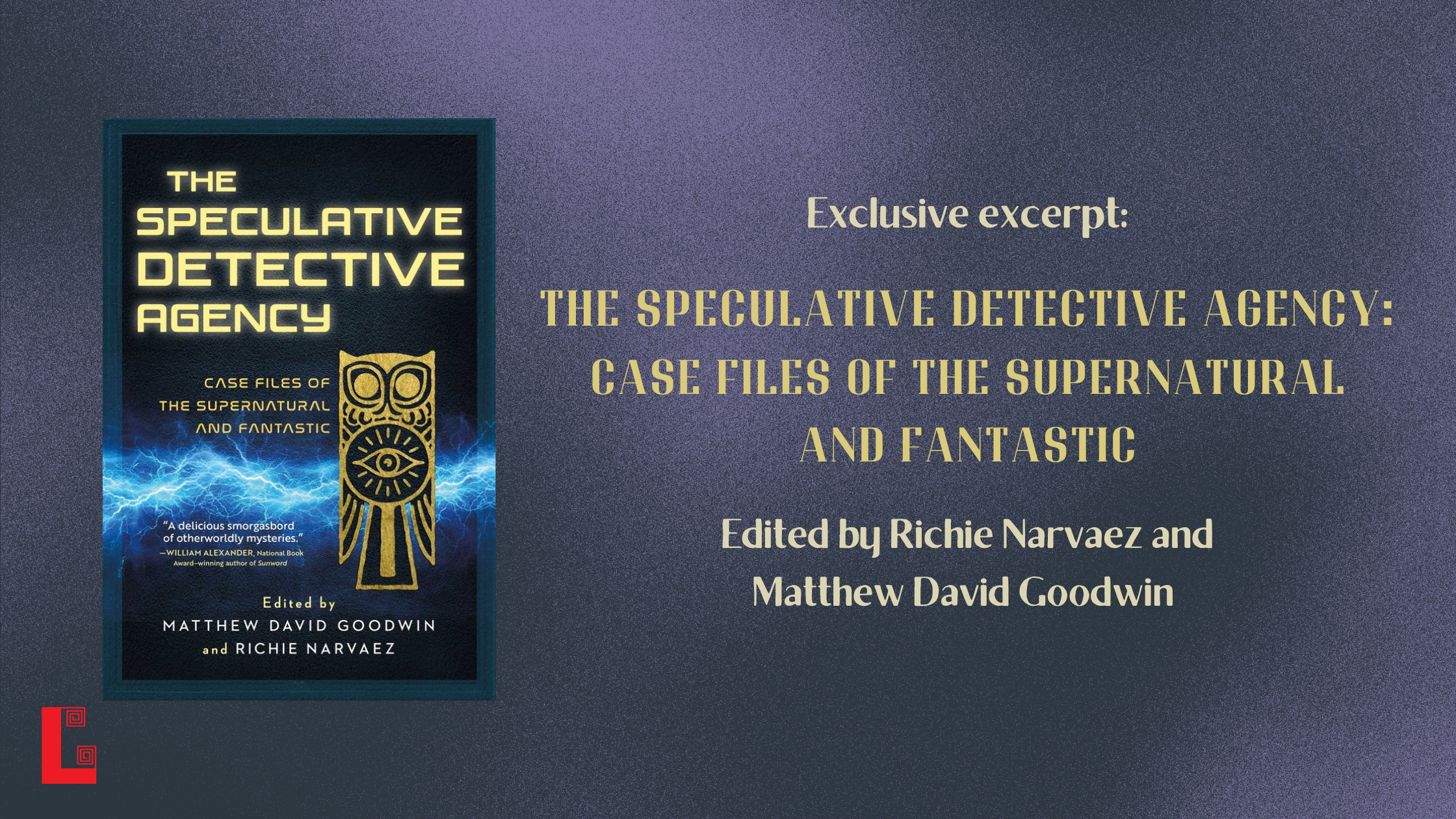
Latinx in Publishing is pleased to exclusively reveal a story from The Speculative Detective Agency: Case Files of the Supernatural and Fantastic, edited by Matthew David Goodwin and Richie Narvaez (out on October 6, 2026) courtesy of Diversion Books.
Trust the Mystery
The Speculative Detective Agency is a global organization of agents confronting cases that defy conventional logic: haunted environments that resist documentation; a Bloody Mary sighting at an elementary school; half a demon terrorizing a neighborhood; and an office staffed entirely by functional zombies. Released to the public for the first time, these cases create a mosaic of strange investigations filled with monsters, myths, and personal mysteries reflecting our fractured yet shared global reality where borders blur, consequences ripple, and no story exists in isolation.
Acclaimed sci-fi/fantasy, crime fiction, and horror writers have been commissioned to contribute, including Scott Alderberg, Frederick Aldama, Heather E. Ash, Megan Chee, Victor De Anda, Alex Grecian, Alex Hernandez, Monique Laban, Lincoln Michel, Richie Narvaez, Stephanie Nina Pitsirilos, Nadia Amina Rabbani, Karlo Yeager Rodriguez, Lekha Sen, Amber Sparks, and Martin Willis.
* * *
“El Gato Gris”
The instant Agent Araceli Turey touched the handle to Joaquin Henriquez’s room in La Palmita Nursing Home, cold electricity sizzled up her spine. She opened the door and stepped into what she knew to be 1930s Cuba. A night-club, a smaller, less glitzy Tropicana. The heavy phantoms of rum and cigar hung in the air. Live music blared and gor-geous dresses whirled. No one noticed Celi in her sensible business-casual attire, hair in a ponytail, smartwatch aglow. She was the ghost here, a psychometric vision.
She drifted deeper into the club trying to take it all in.
The song wound down and a spotlight scorched a stage at the far end of the dancehall. Without taking a step, she floated toward it. No one saw or felt her pass through them. They were enraptured by the dapper man onstage, pinstriped suit and boater hat stylishly askew on his head. The large banner draped over the stage read, “El Gato Gris, Joaquin Henriquez, Mago de Matanzas.” So he was one of the eight people that had died in the nursing home—all at once—no discernible cause of death. The event had been strange enough that the home admin had called the Speculative Detective Agency.
Everyone whistled and cheered as a lovely woman, dark skin gleaming in a vibrant, stupendously flared skirt and ruffled sleeves, sauntered onto the platform and took Joaquin’s hand. Her smile a beaming moon in the night. He dipped her as if they had finished a dance, but of course they were just beginning. The people around Celi went silent. Their breath stolen. El Gato Gris took a showy step back and his lovely partner hung in the air, balanced on just one heel. Physics be damned. He spun her slowly, allowing them to admire her beauty and grace, until the wrongness—the impossibility—of her pose sunk in. She glinted like a knife unhurriedly rotating on its point. Suddenly, she kicked her foot off the ground and crossed her legs. No smoke. No mirrors. She just luxuriated in the empty space above the stage like a cat on a windowsill. The crowd erupted in applause. Joaquin looked over his hovering partner, through the mass of partiers, and stared directly at Celi. A brazen smile spread on his face, making one side of his pencil mustache tick upward with the precision of a clock hand.
* * *
“¿Estas bien?” the nursing home administrator asked with some concern in her eyes. The transition back to the pain-fully dreary present shook Agent Turey. She was back in the nursing home hallway, and it was a vacuum compared to the sensory explosion of the rumba hall.
“Yes, I’m fine,” she managed, letting the wave pass. She focused on the sound-muffling carpet, the dated pastels of the walls, the cheap, inoffensive beach scenes hanging on them.
Celi didn’t have to be psychic to know what this woman was thinking: She’s too young for this. Couldn’t the agency have sent a man? Benny Cabrera, the lead detective in the Miami office, had a deep, soothing baritone.
But Celi wanted this assignment. She needed it. “Si. Todo bien.” Her own voice sounded high-pitched and high-strung . . . a little whiny.
Celi realized she had never actually gone into Joaquin Henriquez’s room. She had been stuck there in the hallway, hand on handle. The woman probably thought she was having a panic attack or, worse, suffering from impostor syndrome. She checked her spirit box, and it told her what the vibrat-ing atoms in her fingertips were already shouting: The room buzzed with energy.
“You said there wasn’t a storm last night that could’ve cut off the power, shut off the AC? This is summer in Florida. The heat could’ve killed everyone.”
“No storm, Agent Turey, and we have generators for hurricanes and things like that. We take good care of our viejitos,” the woman—“Sandra,” the name tag read—said, shaking her head. Accusations of negligence, abuse, and wrongful death were being lobbed at the nursing home since last week’s tragedy. “Remember. I called you.”
Celi had checked the weather on the night of the deaths. Hot, in the eighties that night, but no storms to take out the power. She’d poured over the coroner’s report. All patients—with ages ranging from seventy-three to ninety-nine—died of a stroke. Possibly overheating, but their body temperatures were normal when the paramedics arrived.
The news vans had already moved on in search of fresh carrion. Agent Cabrera urged her to file a report and close it up. Lots of old people died in nursing homes. Her grandmother Lola died in a place like this. And this was one of the smaller incidents. Just last year, twelve people had died in a Broward County home. But this situation didn’t add up. Every case Celi studied had a catalyst: bad weather, high tem-peratures, abusive staff, horrid living conditions, a homicidal patient—she couldn’t find one here. Except that this room shuddered at her touch.
“Why haven’t you gone in?” Sandra asked, growing agitated.
Celi had toured the entire facility with no problem at all, but this door. The vision. Had it rattled her? “The room feels,” she started to say . . . awful? icky? low vibrational? She looked for a more professional word. “Heavy.”
Sandra sucked her teeth, opened the door to the room, and squeezed past her. “Dale, entra.” The room was utterly ordinary. Beige furniture. A neatly made bed. Pictures of some kids at Disney World. Pill bottles everywhere. The miasma of old age. It could’ve been her grandmother’s room, only the little San Lazaro figurine that never left Lola’s nightstand was missing.
The attendant motioned to a vintage poster of El Gato Gris theatrically sawing his partner in half. “Joaquin was a stage magician back in Cuba.” Celi could see the young woman’s name just under his, y La Pícara Justina. Painted devils hooped and hollered around them as he hacked away with that roguish smile. The poster had faded from years of being hung up too close to the window.
“Was La Pícara Justina here too?” Celi asked, methodically sweeping her spirit box around the room, over the bed, the drawers, the poster. The modified radio hissed and spat. The word “juego” came through clearly then . . . more static.
“Who?” asked Sandra.
“The girl on the poster.” Celi adjusted the dial to a differ-ent frequency.
“Oh no. We don’t know who that was. He never mentioned her. Probably a girl from the cabaret he performed at.”
“I’ll bet,” she mumbled to herself. The spirit box seemed to agree. After a few seconds, without taking her eyes from her little device, Celi ventured, “Why did you call the Speculative Detective Agency? This tragedy seems so mundane.”
“So you don’t think there is something, no se, supernatural about all this?”
“There’s something supernatural here now. I felt prickles of it when I walked into the building, and I’m definitely picking up something here in this room.” She lifted the spirit box as if to prove there was something scientific about all of this, as if tobacco smoke from a hundred years ago hadn’t raked her eyes out in the hallway. “But I can’t honestly say it caused the deaths of the eight elderly residents. For all I know, these readings could be the result of all the deaths, you know?”
“I see.” The woman’s concerned expression came back, tighter than before. Had Celi misjudged the first look? The unease was not because she was young and inexperienced. She was afraid.
“Why do you think there’s something paranormal about this situation?” Celi pressed.
The woman hesitated for the briefest of moments, chewing her lip, then blurted out, “Margarita said she saw a shadow the night of the deaths. She was making her rounds. It was very big, with wings like chapapote. She thought it was a demon—or Death.”
“Why didn’t you say anything sooner?” Celi rubbed the bridge of her nose, trying really hard not to look exasperated. Did Death not frequent places like this? Was that not the conclusion she arrived at while reading past accounts? “Most people tell us stuff like that up front!”
“I wanted you to say there was something supernatural here first. To confirm it”—she nodded at Celi’s spirit box—“before I said anything. I didn’t want you to think we were crazy. Margarita needs this job.” Ah, if the arcane could be measured like electromagnetism, then it had to be real, something external. Not just a symptom of poor mental health. Sandra sucked in a deep breath and added, “I also need to know there isn’t some demon here taking our viejitos by the handful.”
“I understand.” Celi put a hand on her shoulder. She could sense the kindness emanating from Sandra. Fear too. “If there was a spirit that big and powerful that a layperson saw it, I would’ve noticed right away.”
“Gracias a Dios,” Sandra exhaled.
“You really care about them, don’t you? It’s not just a job?” Celi was struck by the earnestness in her own voice.
“Oh yes, I really do. Les cojo mucho cariño. I’m still very upset by all this and everyone is just brushing it off . . . como si nada!”
“Mi abuelita passed away in a home like this a few years back, during the height of the pandemic. Everything was locked down. I couldn’t visit.” Couldn’t hold her hands, kiss the knotted joints and too-soft skin. Her manos bentitas, as she would call them. That’s what she called Celi’s hands too. “So I’m glad you care. I care too.”
“Thank you. I’ll tell Margarita and the other nurses que no estamos loca.”
“Let me take a few more readings. I’ll solve this mystery and find some justice for Joaquin and his friends.” Celi turned and walked out, glad to escape the room. “You don’t need to be here for that,” she said, wondering if having the arcane be real and external made it any safer.
* * *
Celi fastidiously scanned the entire assisted living facility. She even laid her bare hands on certain objects to see if another psychometric episode flared up. She got nothing like she had in Mr. Magician’s room. Around the back of the building, while checking on the generators, a gray cat and a turkey vulture startled her. They looked like they were in deep conversation—an argument—over a tossed-out Wendy’s bag.
She watched for a second, letting the summer heat cultivate sweat beads, like tiny crystal balls, on her forehead and upper lip. Was this a manifestation? Un gato gris. A synchronicity? The spirit box in her damp palm crackled defiantly. The words “Abasí no duerme” came through crisply.
The gray tabby hissed, ears pulled back, legs like tightly coiled springs. The vulture hopped, rattling its spread obsidian wings. Was this just two animals fighting over trash? A chunky black and red lizard, an agama agama, presided over the whole spectacle, with regal—or reptilian—stillness. In the sweltering heat, Celi thought the white of the bag looked like exposed bone, its crimson lettering the splash of blood on a fresh carcass. She took a few steps toward the animals and the vulture, instantly seeing her with its keen raptorial eyes, squawked and flapped away. It heaved its large body to the rim of a dumpster.
The cat ran to her, meowing gratefully. Had she saved him from this shadowy bird of prey? He crooned, rubbing his head on her sensible flats, entwining himself around her legs. She leaned in and scratched the back of his ear, mov-ing her fingers down to the very tip of his chin. No psychic visions, but there was something there. A tingle that moved through the delicate bones in her hands, and up her arm. This striped tabby looked and smelled like an ordinary cat, but . . .
“Joaquin Henriquez?” she said, out loud, feeling com-pletely ridiculous. The vulture beat its wings making the faint stench of rot waft up from the grimy container. The cat purred like a tiny engine, and she swore his smile was too charming, a dainty fang poking out of his mouth.
On impulse, she picked him up, trying to ignore the dusting of cat hair now clinging to her black blouse, and started walking toward her car. “I have better equipment and AC at home. Let’s get to the bottom of this together.”
* * *
Celi’s cozy apartment, with its soft lighting and bookcases, bedecked with romantasy novels and devil’s ivy, was instantly besieged by the feral cat. It bounced around with the fury of a poltergeist, destroying everything it touched.
Celi tried to ignore the beast and focused on researching the best way to communicate with the spirit of the man. She wasn’t a very good medium. Her psychometric touch, sus manos bendita, just gave her impressions, feelings, visuals. She needed clear information. Most of the strategies in the SDA database either involved high ceremonial magic, which she didn’t have time for, or psychedelic drugs, which she refused. What she did have was her dream machine to produce the theta waves she needed to enter a meditative state. Meanwhile, the cat scaled one of her bookcases, knocking a black-and-white photo of her grandmother as a young woman off its altar. He nudged an empty Jane Austen coffee mug off the counter and cracked it. Controlling her rising irritation, Celi sat on her couch and scrolled through different entries, hoping this wasn’t just a regular old, mangy cat unused to being indoors.
She finally found something she could adapt for her purpose. The Chthonic Induction procedure Agent Carol Wachter had quickly developed in the field when a horde of Exus invaded the Bronx in 1978. She could replace the drumming Agent Wachter had used to enter into trance with her dream machine.
The cat tore into the fabric of her couch and she swatted it away. “Calm down!” she snapped as he bolted behind her big, potted Chinese evergreen. She forced herself to take deep breaths, trying to shift her focus on calibrating her dream machine to emit binaural beats, oscillating between 4 and 8 Hz. She settled back and tried to relax.
The cat mewled, jumping back onto her altar and swiping her Abuelita Lola’s Baraja Española off its spot. He was making it impossible to enter a trance state. She shut her eyes tighter. Letting the rhythmic sound wash over her.
“You rely too much on these gadgets,” a male voice rumbled.
Her eyes shot open and a young man in a gray, pinstriped suit and boater hat, exuding Cuban Great Gatsby, sat on the comfy chair next to her couch. He took a drag from a ciga-rette with the languid ease of a cat.
“Joaquin?” she murmured.
He waved away her question. “The drum is sacrosanct. A heartbeat. It commands the ritual. You can’t just replace it with this fancy radio.”
“It worked, though. We’re talking. I knew you weren’t just a cat.”
“Aren’t you going to offer me un cafecito?”
“No.” Thinking it was unwise to give this specter any offerings. “Sorry. I don’t even own una cafetera.”
The age of his eyes betrayed his youthful demeanor. “Your grandmother would’ve been able to do all of this with nothing but un tamborcito, aguardiente and her cards. Very sad how much young people rely on technology these days. ¡Que atraso!”
“You don’t know my grandmother,” Celi said, going rigid. “No, but you lack confidence and faith, Araceli Turey, and that’s a bad combo when consorting with spirits. Are you Cuban?”
“Partly,” she responded dryly. “I’m also half Colombian, born and raised in Miami.”
Joaquin wrinkled his nose like a finicky cat finding his meal lacking, but he tipped his hat and flashed his beguiling grin. “Did you like my magic show?”
“I only caught a bit of it. Wish I could’ve seen more.”
“But you had important work to do. I get it. Thank you for rescuing me from La Tiñosa.”
“Um, you died. She got you.” Celi knew this now the way people just know things in dreams. She had succeeded in fully slipping into the trance. It’s why she wasn’t freaking out. “I don’t know if you can call it a rescue.”
“Ah, yes, she killed me, you’re right, but she tried to take my soul, and you stopped her from doing that. So gracias!”
“The balled-up Wendy’s bag was your soul?” she asked, but her attention was on the room. It shifted slightly. It was her apartment, but also her childhood home. She could smell the oily aroma of boniatos frying in the kitchen.
“Metaphorically,” he said, shrugging, and the smoke from his cigarette undulated up like a cat’s tail.
“Your English is perfect.”
“Oye, I’ve been living in the US for more than fifty years.” He chuckled. “I learned English watching I Dream of Jeannie.” He leaned back and spread his arms, nothing to hide. “But the truth is I’m not really speaking English. I don’t have a tongue, or a throat, or lungs. I’m not speaking anything. You’re interpreting all of this using your brain and you speak perfect English.”
She nodded. The last statement reminded her that this altered state of consciousness could end at any minute. “¡Dale!” she said, getting up from the couch, brushing cat hair off her astral clothes. Her real body was still slumped on the couch. Was she getting better at this? She looked over at the dream machine on the coffee table, her mother’s cof-fee table now, and it, too, had changed, transmogrified into a small, longish drum, like a child-sized conga. “We have a drum.” It was her turn to smile teasingly at Joaquin.
“A Bonkó drum.” He played with his thin mustache, his smug look gone. “The most respected and powerful of the drums. Made of ceiba wood and goat skin. It arouses spirits.” She picked it up. Felt the heft of it in the crook of her arm. A sensation like profound, resonant authority flowed through the palm of her hands. “All right, let’s go.” “Where are we going?”
“To find esta Tiñosa.” Part of Agent Wachter’s Chthonic Induction involved some form of Orphic odyssey that led the Exus back into the underworld—by drumbeat. “I need answers about what happened at the nursing home.”
“I’m not going.” He sunk deeper into his comfy chair, patting a little rhythm on the armrest. “I can tell you what happened. She came for us. All seven of my friends and neighbors. Me too, but, ah, I’m not your typical viejo cagalitroso.”
“You’re a magician, an escape artist,” she added. She noted that he didn’t seem too broken up about losing his friends and neighbors. Her mother always said cats were traicioneros. That feline smile, like the Cheshire cat playing with Alice, crept back across his face. “I’m more than that. I have real power. I’m an initiated ñáñigo, among other things.”
She recalled the way he had made Justina levitate on that stage almost a hundred years ago. No hidden wires or tricks. He had looked about twenty back then—how old had he been when he died in the nursing home? More than a hundred, for sure. More than the range recorded in the coroner’s report. He was powerful. She walked to her front door and gestured for him to follow. “Yeah, you’re also a spirit now.” She rapped on the drum. Boom-Boom-Boom. A heartbeat. “Let’s go, then. I’m going to need the great Gato Gris to pro-tect me, when we find her.” Boom-Boom-Boom.
He got up without protest and followed the drum’s command.
* * *
The underworld looked exactly like Miami. Swaying palms, glass skyscrapers, a tangle of expressways and overpasses, oppressive heat. The breeze carried the saccharine scent of mangoes left to decay on the ground, flies humming. The only difference was the red sky and the thousands of tomb-stones and crypts crowding the ground. The whole place was a massive cemetery, a cosmopolitan necropolis. Each grave carefully tended to with lush offerings of flowers and fruits. Celi felt a little disappointed, like finding your soul was just crumpled packaging for a baconator and fries.
She walked, pulled along by the feeble tug of her drum. Joaquin walked beside her. Sometimes an elegant young man with a spring in his step, other times a cat slinking around stone crosses and weathered angels, now a towering figure wrapped in black and white geometry, gamboling among the graves like a carnival dancer. Reedy music played in the distance, the echoes of a rumba still ringing in your ears long after the party ended. She drummed lightly to the syncopation. Boom-Boom-Boom.
They marched for a while through a whole neighborhood made up entirely of mausoleums. Celi caught herself glancing at the names on the tombs she passed, hoping to see a Dolores “Lola” Turey, but it was hard to read text in this realm and the litany of names meant nothing to her. On the horizon she could see a gargantuan ceiba tree that reached higher than any of the luxury high-rises that poked up from the skyline. The tree called back to the bonkó. Boom-Boom-Boom.
They had also attracted attention. Diablitos, echoing the cartoon demons on Joaquin’s show poster, pranced and giggled around them. She imagined Agent Wachter leading a band of rambunctious Exus back into hell. “We have company,” she whispered. She counted seven of them. Their tiny horns bobbed, and arrowhead-tipped tails swayed to the tempo of the ghost of music.
“Don’t worry about these guys,” he said, and abruptly turned toward them in his monochromatic carnival form and spooked them away. She noticed they didn’t scurry very far on their petite chicken feet and were back to cavorting around tombs a respectful distance away.
“How are you going to find La Tiñosa?” he asked, but Celi could tell that it was a devil he was afraid of.
“Honestly?” She shrugged, letting the sweat drip down her back. “I’m hoping she’s circling high up in the sky looking for your soul to eat and she finds us soon so we can get out of here.” She had no idea where she was or how long they’d actually been walking. It felt like forever and just a few min-utes all at once. “What is that shape you sometimes take?” she asked, her curiosity finally getting the better of her.
“Íreme. It’s the costume I wore for ceremonies as un ñáñigo. We used to drum and dance down the streets of Matanzas. Everyone was fascinated by and terrified of us.” He jabbed a thumb toward the little devils. “Some still are.”
“You’re enjoying being young again, aren’t you?”
“You have no idea!” he roared, but the thought of being bait seemed to have dampened some of his joie de vivre.
“Whatever happened to La Pícara Justina?” she asked, wondering why that girl from long ago had grabbed her imagination. She thought of Sandra’s confusion when she’d asked. “Do you remember her?”
“Ah, of course!” The way he looked at Celi made her feel like a caught mouse. “Esa mulata hermosa. I’ll never forget.” Celi winced. She was trying to help this guy, to be there for him the way she hadn’t been for her grandmother, but at every turn Joaquin Henriquez reminded her how absolutely unlikable he was. She preferred him as a shedding, bother-some cat.
“I don’t know.” He sucked on his cigarette and exhaled sharply through his nose, not noticing or caring about her discomfort. “She stayed in Cuba, I think, and I came here. Well, not here.” He gestured to the rows and rows of graves creating eddies in the smoke. “The real Miami. I’m sure she made a life for herself. She was a survivor.”
Two large ebony wings blotted out the cherry sky. The syrupy, fetid air gusted around them. La Tiñosa, not as an actual vulture but a giant, monstrous íreme version of one, alighted on a leaning white cross. She tucked her wings close and studied him, first with one eye then the other. “No seas mentiroso, Joaquin,” the creature screeched.
Fear gripped Celi so tightly that she almost shook out of her trance, but in her heightened state she noticed that the name on the grave the scavenger had perched upon read: Justina Sandoval. She drummed and focused on the name for grounding, willing herself not to wake up on her sofa.
With each steadying breath, the creature shifted and congealed into the form of a young woman, in her rumbera dress. This time, however, the fabric shone a buzzard black.
Celi cleared her throat, grateful that the entity now looked, well, a little like her. Like her grandmother would have in her youth. “Justina?” Celi asked. The woman curtsied as if she were onstage, and Celi continued, “Did you kill all those people in the La Palmita Nursing Home?”
“¡No!” She touched a nail to her plump lip, a parody of thinking it over. “Well, maybe, but it was his fault.” She waved her hand at Joaquin and the bangles at her wrist chimed musically. “¡Ere us parasito asquerozo!”
Celi looked back at him. “Your fault? You’re a parasite?” “She’s crazy! She’s always been in love with me. Jealous and crazy!”
And you’re an expert gaslighter, Celi thought. “She came for you and you—what, sacrificed your ‘friends and neighbors’ to save yourself?” The diablitos in the periphery jeered like an unruly audience. Seven of them, Celi thought. The pieces fell into place. She might be young, but she was a decent detective, a detective with manos benditas. She grabbed one of Joaquin’s wrists and pulled him close. The wrong, unpleasant awareness she’d felt at the entrance of his room rushed up her arm.
“No,” he protested, trying to pull away.
“No,” Justina repeated, in agreement. She hopped off the grave marker and stalked toward them. “It’s worse than that! He was feeding off of them for years. He had sunk his little cat claws and fangs into them, and he was drawing ashé from those poor people. I didn’t know. When I killed him, it sev-ered his connection and they all died. I was so shocked that it gave this descarado the opportunity to sneak away!”
“Those old people were going to die anyways!” he shouted. “You’re old too!” Celi shot back.
“It’s all you do.” Justina advanced, wielding an accusatory finger like a rapier. “You’re a leech. You made me fall in love with you. My father took you in as a sobrino. He initiated you into Abakuá, Ocha, Mayombe. People warned him not to teach this blancito come mierda all our secrets, but we loved you.” Her voice caught and for an instant she was a vulture again forcing a hunk of meat down her gullet.
“You abandoned her? Stole her culture—her faith—made yourself famous and then you left.” Celi could see Justina nodding from the corner of her eye, but she glared at Joaquin. “I loved her,” he countered. “Honestly, I did! But it was a different time. I had to marry and settle down with a white woman. It was expected.”
“Bullshit,” snapped Celi, her anger too palpable.
Justina’s head cocked with some avian surprise. She let go of him. “You’re still a racist prick. I caught your reaction when you asked what I was.”
“I’m a product of a different time.” His voice raw, frantic, and edged with dread.
That much was true, and his time had passed. He was already a ghost. Irrelevant. She turned to Justina. “So was this all about revenge? Are the rest of the residents of La Palmita Nursing Home safe now that you have your quarry?”
“They’re safer without him. Yes.” Then she became thoughtful, truly pensive, no melodrama. “It wasn’t revenge. No. If that were true, I would’ve come for his miserable carcass a long time ago. I died in the ’90s. I did make a good life for myself. I moved on!” She jutted her chin toward the fat little lizard, black and red, sunning on one of the tombs, attentively watching them. “But I was called to bring him in. Divine timing. Joaquin Henriquez, mago, gato, lardón, tremendo hijueputa, is ready to be judged.”
“No!” Joaquin panicked and ran through the graves, smashing offerings as he scrambled. The diablitos were instantly on him, more vicious animals than comical demons now. A pack of coyotes hunting a cat. He yowled as they dragged him off into the shadows of an open sepulchre.
And Celi began to fade. She was being sent back to the world of the living. Mystery solved. She understood that it was the agama agama’s doing. The lizard had gifted her this tiny peek behind the veil, graciously allowing her to complete her assignment. But it was over now. Justice had to be served.
“What’s going to happen to the little devils now?”
Justina tried to lay a comforting hand on Celi’s shoulder, but it just passed through her. “They’re free to experience whatever afterlife is waiting for them now. They needed this. They’re just taking back pieces of themselves he stole from them.”
Celi nodded. She thought of her grandmother, not here, but still with her, and felt some closure, too, because she had been able to assist La Pícara Justina with her final show.
She dipped her head toward the reptile, and it bobbed up and down, doing push-ups like lizards do. Celi gave Justina a sympathetic little smile. “And you?”
“I’ve been free this whole time.”
* * *
Celi opened her eyes in her apartment and released a sigh that threatened to become a sob. She was soaked in sweat. The grit of grave dirt still on her tongue. Blood orange light poured in from her window and for an instant she feared she was still in the underworld. But no, the room cooled her damp blouse, humming with AC. The window blazed not the color of cataclysm, but with the spectacle of a Miami sunset. She looked at the mess that damned cat had made. It didn’t matter how many arcane cases she worked, her mind always scoured for proof it was all real. The Bonkó drum was gone, of course, replaced by the dream machine cradled in her arms. She chuckled when she noticed that she had unplugged it when she had picked it up. Joaquin had been right about one thing—she relied too much on these gadgets.
He was gone now. For good. Case closed.
She forced herself to move, grounding herself in the mate-rial, and put her grandmother’s items back on the shelf. She was glad that Lola hadn’t been in that gaudy spirit world. Her grandmother deserved better. And she was able to help—in her strange way—the residents of La Palmita. That honored her grandmother. She lit a cone of frankincense and left it in front of the picture, then got her laptop out and began to type her report before it all faded like a dream. Her too-sensitive fingers hit the keys to the distant beat of a drum.
Tomorrow, she would go back to the nursing home and tell Sandra that all the demons were back in hell.
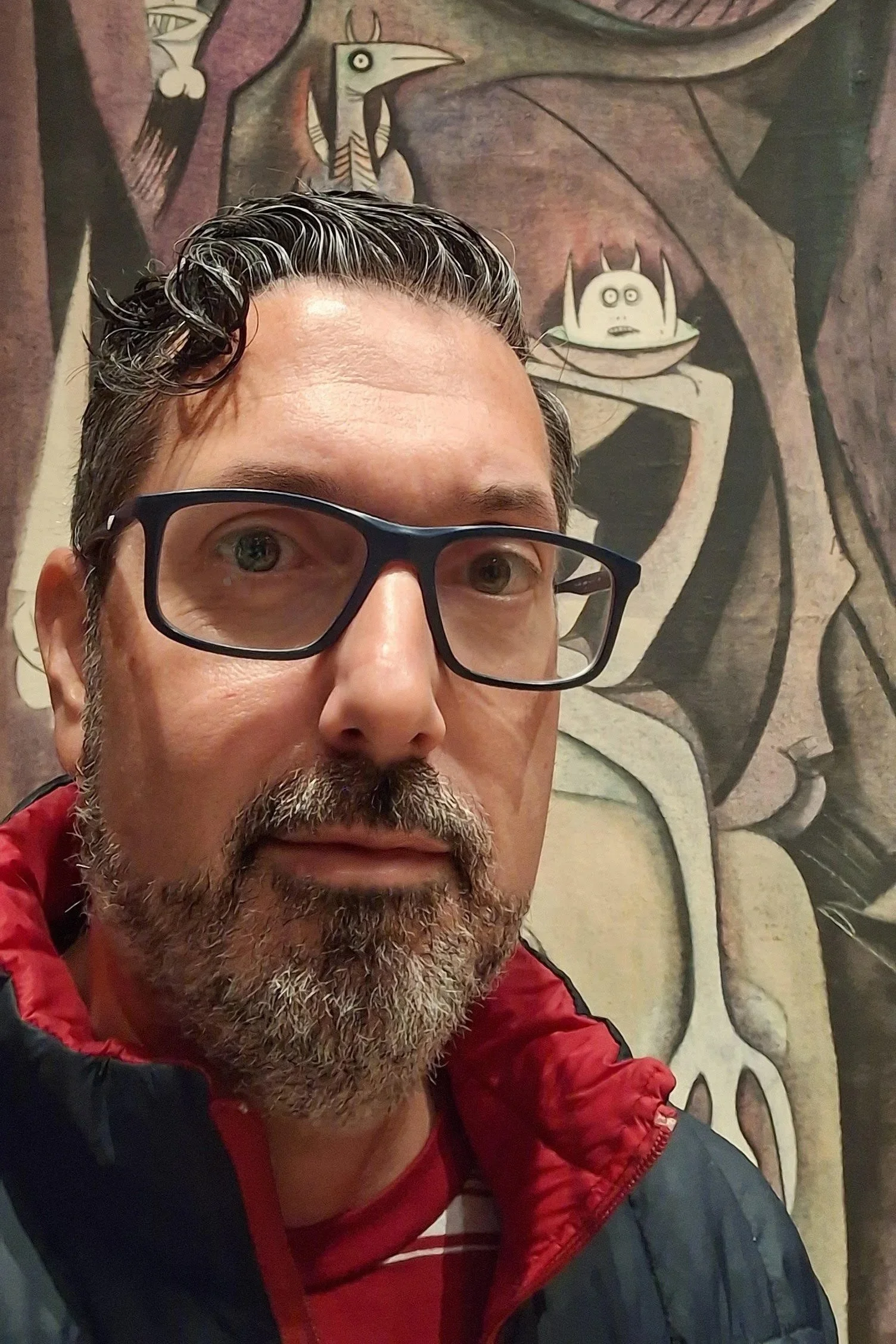
Alex Hernandez is a Cuban-American speculative fiction writer, editor, and artist based in South Florida. He co-edited the acclaimed anthology Speculative Fiction for Dreamers (Ohio State University Press) and, more recently, Not Your Papi’s Utopia (Mouthfeel Press). His work often explores themes of posthumanism and esotericism across genres such as fantasy, space opera, and biopunk.
Matthew David Goodwin is an Associate Professor in the Chicana/o Studies Department at the University of New Mexico. His research is centered on Chicanx/Latinx science fiction and Critical Mystery Studies. He is co-editor of the Latinx Archive speculative fiction trilogy, including Latinx Rising, Speculative Fiction for Dreamers, and Not Your Papi’s Utopia. He has a PhD in Comparative Literature from UMASS Amherst and is an active agent in the very much real Speculative Detective Agency.
Richie Narvaez, born and raised in Brooklyn, New York, is the award-winning author of the novels Hipster Death Rattle and Holly Hernandez and the Death of Disco, as well as the short story collections Roachkiller & Other Stories and most recently Noiryorican. His writing centers on Nuyorican and Latinx experiences, using multiple genres, including crime fiction, horror, literary, and speculative fiction. A recipient of a Letras Boricuas Fellowship, he teaches writing at Sarah Lawrence College and the Fashion Institute of Technology.