Author Interviews

Review and Author Q & A: Plátanos Are Love by Alyssa Reynoso Morris; Illustrated by Mariyah Rahman

I grew up eating platanos: mangú, tostones and maduros (or fritos as we like to call them in our household,) so you can imagine how excited I was when I learned of a children’s book dedicated to one of my first loves!

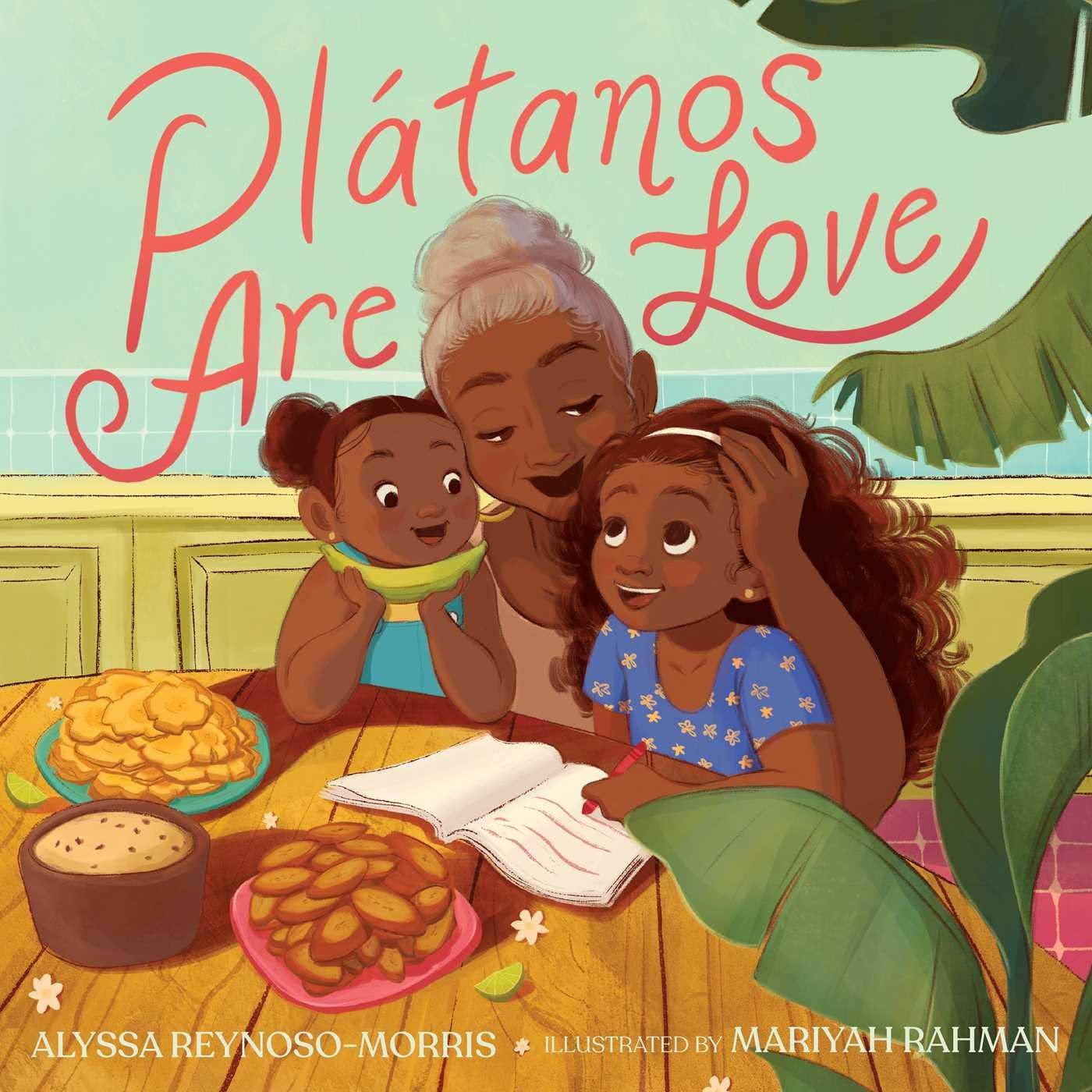
Plátanos Are Love by Alyssa Reynoso Morris is a beautiful homage to culture, history, traditions and family. The story starts with a young girl who goes produce shopping with her grandmother. This introduction sets the foundation for the journey in which the little girl takes the reader. As she learns from her grandmother how to cook plátanos, in a variety of ways, she also learns about the importance that they hold in her ancestral history. Ultimately, we find the young girl passing on the knowledge of what her grandmother has taught her, in the kitchen, to her little sister; giving us a full circle heartfelt moment.

The book is filled with wondrous attention to detail, starting with the beautiful bright illustrations by Mariyah Rahman. From the grandmothers hoop earrings, to the array of hairstyles on the characters, I felt seen. The Spanish interwoven throughout the story, welcomes us to a Spanglish filled world; one many of us can recognize. However, it’s the reader care that we see via a glossary, for those unfamiliar with the Spanish words, and the recipes for the wonderful dishes, mentioned throughout the book, that really brings the book together.

I had the opportunity to ask Alyssa Reynoso Morris a few questions about Plátanos Are Love. She spoke about the inspiration behind the book, the importance of knowing our history, what we can expect next from her and of course, how she prefers her plátanos.

“Plátanos Are Love” by Alyssa Reynoso Morris is a beautiful homage to culture, history, traditions and family.

Tiffany Gonzalez (TG): What or who inspired you to write this book? 

Alyssa Reynoso Morris (ARM): I wanted to be a writer since I was 7 years old because I grew up with my Abuela—the original storyteller. She had a second-grade education, but that didn’t stop her from telling the best stories that captivated EVERYONE’S attention. I remember looking up to her and wanting to be like her. I think she knew that because she would rope me into “helping” her tell her stories. These are some of my fondest memories as well as the time we spent in the kitchen together. My love of my Abuela, her stories, and the food we made together inspired Plátanos Are Love.

TG: Immediately, I was drawn in by the Spanish words and loved the strong presence that "Spanglish" had throughout the book. It reminded me of my upbringing and of my day to day, in all honesty. Was that always the intention or did that come later on in the process of bringing this book together? 

ARM: I love this question. The Spanglish was intentional. Growing up I spoke Spanish at home and English in school. Then as I got older my English proficiency outpaced my Spanish. I found myself speaking in Spanish and in Spanglish every chance I got to preserve the language. With time I learned to take pride in my Spanglish and my goal with my writing is for it to be as authentic as possible. When I started writing it I had sprinkled in Spanish and fortunately my editor asked me to lean into it more, so I did and I'm proud of what we created.

TG: The history of our ancestors played a very important role in the book. Can you speak on why this was important for you to highlight?

ARM: I'm a political science major and I'm obsessed with how our history affects our present. Growing up I learned about Trujillo and the Parsley Massacre but I didn't learn about slavery and colonization until I was in school. I think it's important for kids to learn where they come from. I think kids should know how resilient their ancestors were so they know they are also resilient and can do anything they set their mind to. 

TG: It's essential for kids to see books that reflect their cultures; that reflect who they are. The one book I read as a child that highlighted Dominican culture has stayed with me till this day. Will you be continuing this work with future projects? Can we expect other aspects of Dominican/Puerto Rican culture or even just latinidad highlighted? 

ARM: I love this question and the answer is YES you can expect more Latinidad to come in my future works. My Dominican and Puerto Rican culture and experiences are such huge parts of my identity and storytelling that I can't tell stories without incorporating it in. My second book The Bronx Is My Home is a love letter to the Bronx from the perspective of a Black Puertorican boy. There are references to Latiné heroes like Sonia Sotomayor and AOC. My third book is called Gloriana Presente: A First Day of School Book and it starts with Gloriana's Abuela soothes her first day of school nerves by telling her stories about their family home in la República Dominicana. Gloriana is uncertain about how to exist between her two homes, or how to make new friends between her two languages. This imaginative picture book celebrates the magic of existing in-between, and the transformative power of self-soothing to build confidence. I think immigrants and particularly the Latiné/x/o community will resonate with the text. 

TG: Okay, if you had to choose one: tostones, maduros or mangú? And why? 

ARM: Asking me to pick one is like asking me what my favorite book is. I just can't choose one because it really depends on my mood. When I want something sweet I go for maduros. When I want something crispy I go for tostones. Mangú is great when I want to feel full and am trying to be healthier as it's not fried. I also love mofongo, pastelon, and alcapurias but we needed to edit them out of the book because the manuscript was getting too long.
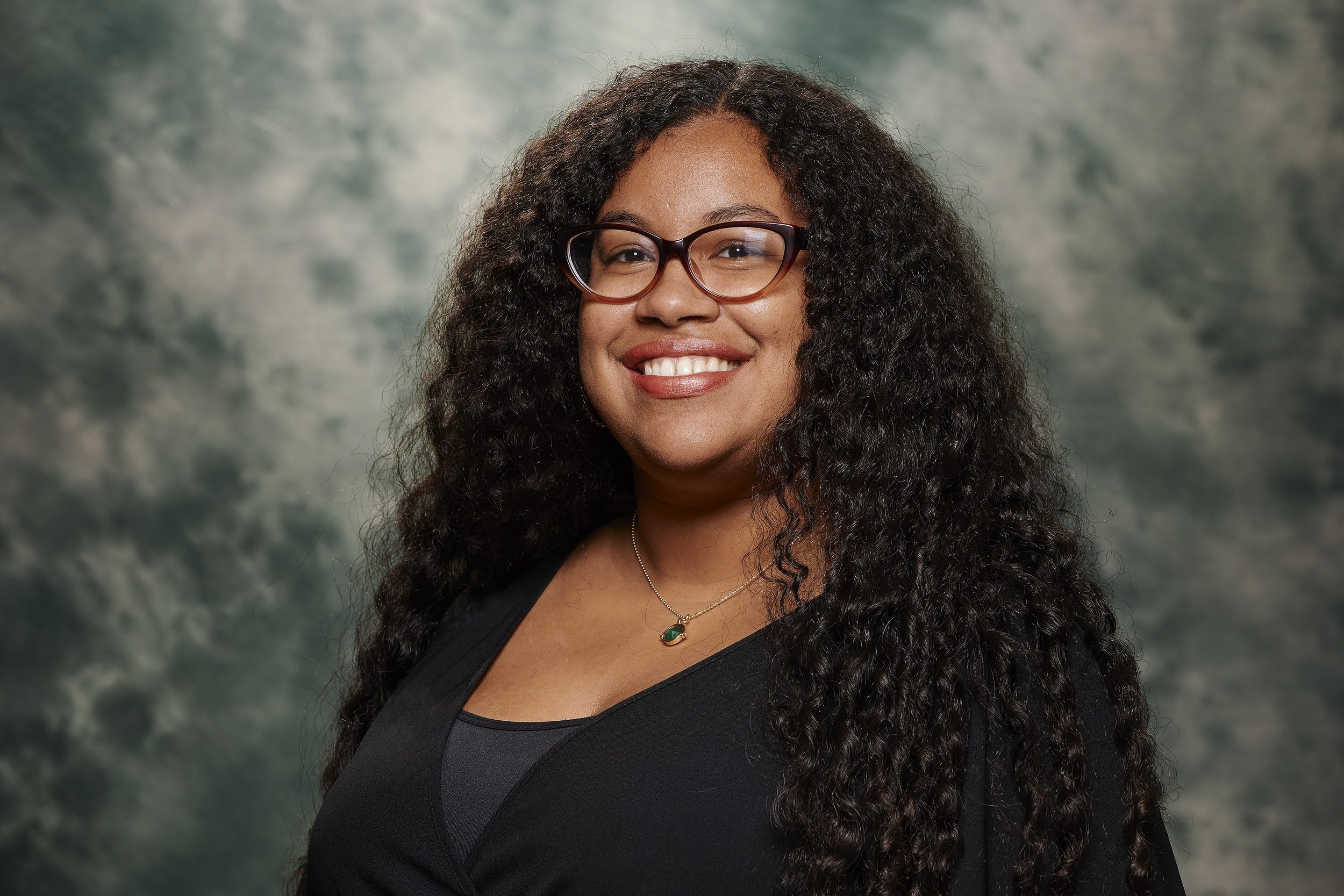

Alyssa Reynoso-Morris is a queer Afro-Latinx Dominican and Puerto Rican writer, wife, mother, and community organizer. During the day she is a chief of staff working with community members, nonprofit organizations, and government officials to make the world a better place. Then she puts her writer's hat on to craft heartfelt stories about home, family, food, and the fun places she has been. Alyssa was born and raised in the Bronx and currently lives in Philadelphia with her partner and daughter. Alyssa is honored to be a Musa with Las Musas Books which celebrates the diversity of voice, experience, and power of Latinx children's authors. She hopes you enjoy her stories. You can visit her website at alyssaauthor.com.
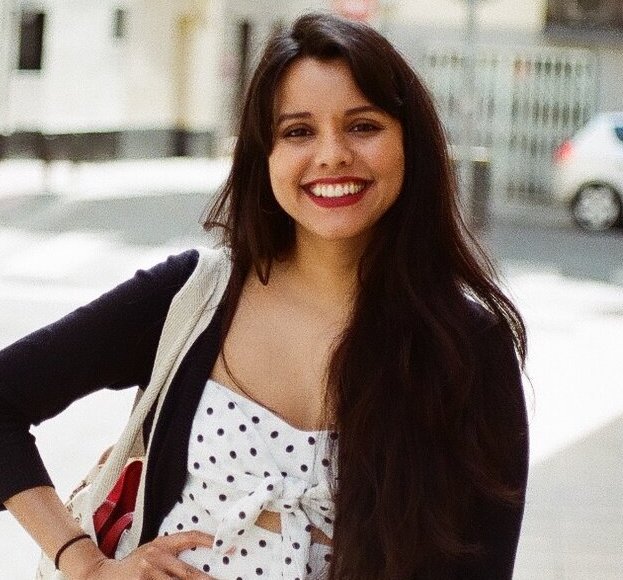
Mariyah Rahman was born and raised in Trinidad and Tobago. She spent her earliest years climbing trees, digging for fossils, and drawing on walls with crayons. Today she is an illustrator for children's books and entertainment but has still never found a fossil.

Tiffany Gonzalez is the Marketing Manager at Astra House and the Communications Co-Director for Latinx In Publishing. She previously worked in Production at HarperCollins Publishers. She has worked on the Publicity and Marketing campaign for Dreaming of You by Melissa Lozada-Oliva and on the Marketing campaigns for Becoming Abolitionists by Derecka Purnell, The Sex Lives of African Women by Nana Darkoa Sekiyamah and National Book Award Fiction Finalist The Town of Babylon by Alejandro Varela. She has earned her Bachelors and Master's degrees from Rutgers University - NB. She is Dominican-American and fluid in Spanish. She is a Publisher’s Weekly 2022 Star Watch Honoree. You can follow her on Instagram @wandering_tiff_ or visit her website at wanderingtiff.com

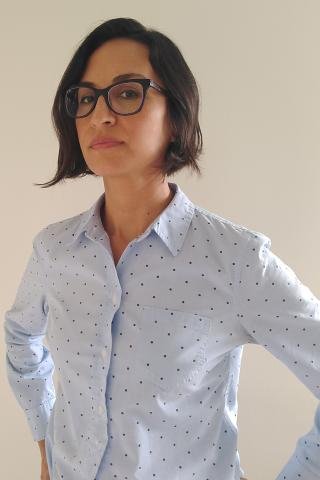
Interview with 2023 Whiting Award Fiction Winner Carribean Fragoza

Carribean Fragoza, author of the critically-acclaimed story collection Eat The Mouth That Feeds You, is one of the latest winners of a Whiting Award! The Whiting Awards are given annually to ten emerging writers in fiction, nonfiction, poetry, and drama. They are based on early accomplishment and the promise of great work to come. We were excited to catch up with Carribean and ask her a few questions.

Toni Kirkpatrick (TK): What was your first thought after you learned you won a Whiting Award?

Carribean Fragoza (CF): I flickered between two feelings, the first one being the feeling of being fully seen. This feels odd to say because I know that people I consider my community have been seeing me and my work for a long time. But when I took that phone call from the Whiting, and they told me how much time and energy had been invested into following and selecting each of the winners, I experienced maybe a different kind of care in that level of attention. The other feeling I kept flickering into was astonishment which is a kind of detachment from any one emotion or thought. Like is this really happening to me? I’m still sort of cycling between these, plus the thrill/mild terror of “what comes next?”

(TK): You have long been doing work to shed light on the culture and history of South El Monte. How does your hometown influence your fiction?

(CF): South El Monte and El Monte are almost always in my fiction. Sometimes it’s more in the forefront as a specific set of locations that I have in mind for my stories and sometimes it’s more of a mood or vibe. South El Monte and El Monte have a very distinguishable vibe. I see and feel it when I go back home to visit and I can see it in your Bolero of Andi Rowe collection, Toni, as well as in Michael Jaime-Becerra and Salvador Plascencia’s work. Also, every time I’m back in SEM/EM, I notice something new or something will catch my eye and it will immediately inspire something in me. They might be very ordinary things, like a mother pushing a stroller down the street or a kid eating a popsicle, but I feel them very deeply.

(TK): You are also the Prose Editor for Huizache, which made its return last year. What are you seeing these days from Latine writers and what excites you? 

(CF): I’m very honored to be on board as Huizache’s Prose editor. And so far, what has excited me the most is work that feels urgent and necessary. These are stories that feel like they need to be told and something very important is at stake for the narrator and other characters (and the author!). The style and risks that writers are taking are responding to the world with all of its beautiful and awful complexities. The voices they are developing in the work are forged from survival and wrought with sharp intelligence. There's a lot of power there.

(TK): What is your advice for Latine writers as they seek to publish their work and find recognition?

(CF): I suppose the best advice I can think of right now is to encourage writers to write stories that feel essential to them and to bring forward voices that are clear, strong, and have something that they need to say. Get in touch with the raw nerve of the story and others will feel it too. And perhaps more importantly: JUST KEEP WRITING. The publishing and awards will come, but most often we don’t have a lot of control over that as writers. But writers gotta write. And writers have to keep learning and growing and getting better. With that said, we also need more Latine/Latinx editors, agents, and other publishing industry folks to create a literary ecosystem that is more supportive of Latine/Latinx writers.


Carribean Fragoza is a fiction and nonfiction writer from South El Monte, CA. Her collection of stories Eat the Mouth That Feeds You was published in 2021 by City Lights and was a finalist for a 2022 PEN Award. Her co-edited compilation of essays, East of East: The Making of Greater El Monte was published by Rutgers University Press and her collection of essays Writing Home: New Terrains of California is forthcoming with Angel City Press. She has published in Harper's Bazaar, The New York TimesZyzzyvaAltaBOMBHuizache, KCET, the Los Angeles Review of Books, ArtNews, and Aperture Magazine. She is the Prose Editor at Huizache Magazine and Creative Nonfiction and Poetry Editor at Boom California, a journal of UC Press. Fragoza is the founder and co-director of South El Monte Arts Posse, an interdisciplinary arts collective. She lives in the San Gabriel Valley in Greater Los Angeles.

Toni (Plummer) Kirkpatrick grew up in South El Monte, California. A Latinx in Publishing board member, she lives in the Hudson Valley, where she acquires, edits, and writes fiction.

Interview with Margo Candela author of The Neapolitan Sisters

Latinx In Publishing had the opportunity to ask Margo Candela a few questions about The Neapolitan Sisters: A Novel of Heritage and Home.

Latinx In Publishing (LxP): Where did the inspiration for the novel come from?

Margo Candela (MC): Writers are like memory magpies, constantly collecting random bits and pieces of life that might not make sense in the moment, but are too interesting to ignore or forget. When the idea for The Neapolitan Sisters came to me, it already had its beginning, middle and end. Although it was fiction, the story and characters were familiar to me in a way that I still have a hard time explaining. While the inspiration for The Neapolitan Sisters came both from my imagination and from being observant, what really set this novel apart from my previous work was my intention for writing it. I wanted to challenge myself as a writer, but I also wanted to allow my characters to be flawed, difficult and complicated without excuse or apology. 

LxP: One of the primary themes within the story are the types of relationships that exist within families, but also outside of them. Can you talk a bit about the importance for you to highlight that?

MC: It's important, sometimes more so, for my characters to have an identity that’s not based on being a son or daughter, sister or brother, husband or wife, mother or father. How they function separately from those roles is one I like to explore because a lot of times, Latina and Latino characters don’t get to move away from that primary identifier of who and what they are. When they're navigating life in a larger social circle and away from family, they find themselves relating to friends, partners, workmates with the same skill set that either serves them or keeps them from moving beyond dysfunctional dynamics.

LxP: The sisters dealt with a lot of trauma that they all dealt with in their own various ways. Can you speak on your writing process, how you decided on each of the sisters' journeys, and how they would complement each other?

MC: Having three main characters who told their story in first person was a natural way to delve into how Dulcina, Claudia and Maritza would each be affected individually by their shared trauma. Even though they spent their childhood and teens together, they don't interpret that period of their lives in the same way, but they are strongly bonded because of it. Knowing this about them meant I had to let each sister go where she needed to go, even if it made me uncomfortable or took me by surprise. Once I allowed myself to just write what felt right for each sister, I was able to give all three of them added depth and humanity by accepting their flaws as part of who they needed to be. I really love these sisters and it was such a joy, even if sometimes a painful one, to get to know them and bring them to life.

LxP: What can readers expect to gain from reading The Neapolitan Sisters?

MC: The Neapolitan Sisters is about finding compassion and love not only for others, but for oneself. Dulcina, Claudia and Maritza’s acceptance of who they are to each other is the greatest gift they can both give and receive. Compassion, love, and acceptance are essential components to intimate relationships and the Bernal sisters are, to different degrees, able to realize this by the end of the novel. Once they do, they’re able to move forward with their lives, and also be in each other’s lives. This doesn’t always happen in real life, but it can in books which is why I’m so grateful that The Neapolitan Sisters was published after so many years of waiting for me to be brave enough to write it as best as I could.

ACCESS THE BOOK CLUB KIT HERE.


Margo Candela was born and raised in Los Angeles and began her writing career when she joined Glendale Community College’s student newspaper. She transferred to San Francisco State University as a journalism major, and upon graduation began writing for websites and magazines before writing her first two novels, Underneath It All and Life Over Easy. She returned to Los Angeles to raise her son and wrote More Than This and Good-bye to All That. The Neapolitan Sisters is her fifth novel and her first after a decade-long hiatus from writing. She now lives in San Francisco. Learn more at MargoCandela.com.