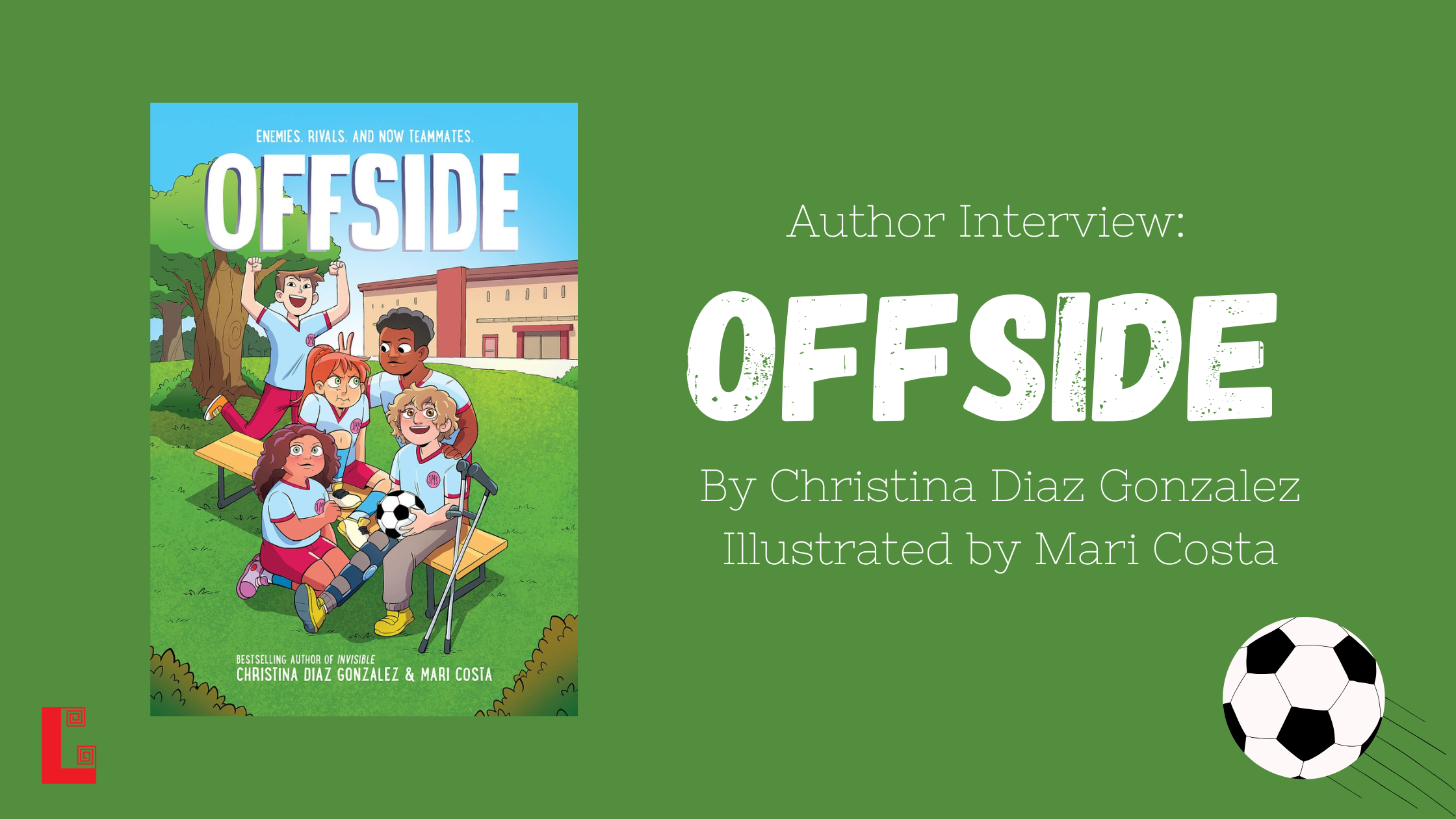
Offside by Christina Diaz Gonzalez is a graphic novel whose story revolves around five middle schoolers; Palmer Jamieson, the writer; Fabiola Amortegui, the new student; Nicole “Nicky” Fernandez, the civil rights activist; Alvaro “Al” Gomes, the soccer team leader; and Sebatian “Seba” Louk, the mediator. They earn their membership on their Jackson Middle School soccer team, while each have their own challenge to defeat. Through school sports, family, and shenanigans, Offside’s quintet demonstrate how differences can make a better and harmonious impact.
Yvonne Tapia: Great to have you here, Christina! Your graphic novel, Offside, gives a modern look to an ancient social stereotype: women not being included in activities, such as sports. What inspired you to write about this concept?
Christina Diaz Gonzalez: Thank you so much, Yvonne! Well, I didn’t grow up being a footballer or soccer fan, I came to the sport late. I came to the sport late as a mom, my kids loved soccer and, I have two sons whom became huge soccer players. I became not only their soccer mom; I became the team mom. Just by interacting with the sport, I would see not only my sons playing but the girls playing, and there were girls teams playing.
Sometimes there was a battle about which team would get the better field, and a lot of that just stayed with me. [After the first graphic novel I had written], Invisible, when it came time to write a new graphic novel, [I decided to showcase] kids who are bilingual; kids who are learning English; who are recent immigrants; and, the differences between the Spanish-speaking communities.
I knew I wanted to touch base with [those topics] again, but I needed a new setting. It seemed so obvious that soccer, being a sport that’s played around the world, that so many people love, that I could start using that as the basis. I started thinking about it more and more, what I had seen firsthand, about the differences between girls’ and boys’ soccer oftentimes. I did research, and learned that in Brazil it was illegal for girls to play soccer until the 1980s. I knew it was something I could really delve into, and use it to highlight how sometimes we have preconceived notions about each other, about boys or girls, and we just have to see each other as human beings.
Yvonne Tapia: This can be tied to present day, how there are still some activities that girls and/or women are not encouraged to do, from sports to careers. For example, construction is a field where it’s not usual to see a woman in that sector.
Christina Diaz Gonzalez: Yeah absolutely, and I think it also comes down to the preconceived notions. If someone is good at something, it shouldn’t matter whether you’re a boy or a girl or other if you’re bringing something to the sport. You should be looked at on your talent, skill, and openness to learn. It is to showcase how we all deserve the opportunity to follow our dreams.
“I hope that people keep the idea that if they see an issue or a problem within their own community, that no matter the age, your voice matters and you can do something about it. ”
Yvonne Tapia: Each character has their own cultural and family background. Fabiola is Colombiana; Sebatian has Peruvian lineage; Alvaro has Brazilian ancestry; Nicky has divorced parents, and so forth, and they each have a different challenge to surpass.
Christina Diaz Gonzalez: We come in from different cultures and different ways of speaking Spanish. I strive to remind people that even though everyone might be speaking Spanish, the accents or dialects can be a little different. In the case of Nicky, her last name is Fernandez but she does not speak Spanish. She carries the name, but she is not carrying the culture because she was not taught that. Yet you have another character, Palmer, who is not Hispanic and not [of] Latino background, and yet he is the one who is mainly bilingual because he learned it at school. I showed how different people from different family backgrounds can come together, and how their language can be a bridge or a little bit of an impediment, and one has to figure out other way to communicate and connect with people.
Seba is Asian-Peruvian, so it’s a different homelife for him. Fabiola has older brothers while Seba is an only child. Everyone has a different family dynamic so that’s one of the main things, to show that we’re all different, and just remind people that we each have our own story.
Yvonne Tapia: Additionally, Fabiola is trying to fit in the school setting; Palmer is healing from his injury while trying to be a writer; Sebatian is trying to bring his classmates together; Alvaro wants a male-only soccer team, and, Nicole is so determined to prove herself. How did you develop the dynamic between the characters?
Christina Diaz Gonzalez: I approach each one as their own character with their rolling backstory, and their own homelife and how that influences them. I wanted to show a little bit of that. Alvaro is adamantly opposed to having girls be on the soccer team. He is absorbed with thinking males are the only ones supposed to be in sports. You see Alvaro’s evolution when he starts understanding what some of the girls are going through and how good they are on the soccer field. His views start to change also when he starts seeing how he is treating his younger sister, based on views trickled down to him from his father.
The graphic novel also highlights the idea that even though you’re young, you can also change your parents’ perceptions. [Switching to Nicky now], I wanted that evolution, I wanted Nicky to go from being so completely self-centered and ambitious to selfless and understanding – it is great to be ambitious, but you can’t lose sight of other people.
It's the learning that you can be ambitious but you can also look out for other people. It was little stories within the story that I wanted to show.
Yvonne Tapia: Yes, and that also highlights another theme; the home environment also shapes how they are as individuals. How did you approach each home environment to reflect who these characters are?
Christina Diaz Gonzalez: I imagined the character first. With Nicky and her ambition, for instance, I thought, “What is influencing her? What else might be going on at home that might be influencing her?” So I wanted to show her home life of divorced parents and always trying to get her father’s attention.
Fabiola, at first, is kind of quiet and does not want to cause a stir vs her two older brothers who are loud, and then she finds a way to stand up for herself.
It was more about thinking what the characters’ personalities are like. What type of homelife would lead or add to their personalities? I would make notes as to what the homelife would be like. I would [ask] “How many siblings? Maybe single child? Give her a pink room? Then, Mari Costa the illustrator, she just knocked it out of the ballpark. She took those ideas, did the sketches and lark-handed all the coloring and brought everything to life. Even though I did not write the [setting description], the illustrator was able to show it. It was great team effort.
Yvonne Tapia: The beautiful illustrations also highlight the language, whether it’s formal or slang, such as “esa vaina.” What was your approach for selecting Spanish slang for the characters?
Christina Diaz Gonzalez: Being from Miami, I wrote it in the language that’s in my head, and I had friends from Colombia and other different ethnicities, read it and to make sure I got everything right. I told them, “If there’s a word like ‘pura vida!’…
Yvonne Tapia: Or “chévere.”
Christina Diaz Gonzalez: Exactly! To let me know if there’s a word they suggest and I can add it, so that helps.
Yvonne Tapia: Great. When you were writing the characters, which one was the most rewarding to develop?
Christina Diaz Gonzalez: The character most rewarding to develop for me was Palmer because he goes through the evolution of always considering himself only an athlete. He has to figure out, “What else can I be if I cannot be an athlete?” He has to try something new out of his comfort zone, such as managing the team.
Yvonne Tapia: Which character was the most challenging to develop?
Christina Diaz Gonzalez: I think Al was the most challenging character to write because I knew he was going to be difficult in his personality. He has beliefs that are opposed to mine and I had to try making him a sympathetic character. Al is someone who you start understanding a little bit more [as the story goes], and I wanted to show that evolution without being too simplistic like, “Oh now we’re all friends and now we all get along.”
Yvonne Tapia: Definitely, and without including spoilers, when one reads about Al’s background, the reader might think it’s just one parent figure that’s influencing him. But then the reader finds out there’s more beyond that. What is one thing readers will be surprised about when they read Offside?
Christina Diaz Gonzalez: I think that a lot of readers think it’s just going to be a soccer story. A story about a soccer team. I think it’ll be surprising when they realize that it’s really a story about friendship and growing up challenging your own preconceived notions. There’s a much bigger story than just about a soccer team.
In terms of the word bubbles – in a graphic novel, you’re very limited to how much dialogue you can put in since it has to fit into the word bubbles. [Since] I try to be authentic to the characters and if the characters are predominantly Spanish-speaking, they are going to be Spanish-speaking in the world. I am also cognizant that the person reading a book might not understand Spanish, so I needed a method to have the translation in Offside.
I did not want it to be just “oh it’s translated for the reader.” That takes up more space in a graphic novel, so the dialogue had to be as succinct as possible, and the [word bubbles with the translations were placed]. I relied on the artwork to be a third language. There’s English, Spanish, and the art to tell the story.
The art is incredibly important, because even though I might be telling the illustrator in the art notes what is happening, so they can understand what’s happening in the background, “this character looks really angry, etc.” they have to not only show the characters, they have to show the surrounding, and show the emotion.
Yvonne Tapia: Is there an illustration in the story that might surprise readers?
Christina Diaz Gonzalez: Yes there’s a couple – I love where Nicky is sitting in her room and Al is sitting in his room and they are in juxtaposition in the illustration. Readers see how different they are and the details in their rooms show you a bigger understanding about their home life. You also see the page where Palmer explains to his mom how he translates – the words arrive to his brain which is almost like “steam-punk” style, and he has to translate everything into English in his brain, and then he can translate. A lot of readers will find that way of processing relatable.
Yvonne Tapia: That brings us to how the household influences them as well. How did you develop Al, given how his family history goes beyond his parents?
Christina Diaz Gonzalez: I wanted to show that people’s belief systems sometimes come from more than just our immediate family. That’s why I wanted to bring in Al’s grandfather who does not even live with them, and Al’s father just worrying about what his father will think about Al and his soccer team. It goes to preconceived notions of what you think someone else is going to think, and it is easier to just ask and have a discussion. The belief systems may or may not be true and that can influence people and multigenerations.
Yvonne Tapia: Absolutely. In this graphic novel we see how the students are shaped by interactions with each other as well. What do you hope readers learn from the book?
Christina Diaz Gonzalez: I’d like for readers to enjoy the experience of seeing these five main characters with their journeys. For it to be like going to the movies where they escape into a world. Readers can also learn to consider other people, and that other people may be more than what they appear to be. We don’t always know what’s really going on in people’s lives unless we are curious and just ask, and get to know them. After reading Offside, hopefully walk away with a better understanding of not only these characters but maybe other people in your community. This graphic novel can also assist a person in reconsidering their opinions of other people.
Yvonne Tapia: Beautifully said. How should Offside be incorporated in the classroom?
Christina Diaz Gonzalez: I hope that it’s for everyone, not just for people who love sports. Sports is one way to bring characters together and this book is more than that – it’s a story about friendship, rivalries, interacting with people that are not like you and that you might not like too much, but learning more about them so that you can work together respectfully.
Yvonne Tapia: What would you say to someone who has not picked up a graphic novel before?
Christina Diaz Gonzalez: Graphic novels are an incredible way to read a book. It is also important reading because it is using a different part of your brain. It does so because when you’re reading a traditional novel, it is all words and the author is really having to paint the picture. With a graphic novel, you have to use other skills – you are learning visual literacy – where you’re reading the words and you’re following the story with the dialogue, and you’re also simultaneously having to look at the pictures and interpret what is happening visually. It’s a different form of reading and it is great especially for reluctant readers who may be put off a little bit by just seeing so many words on a page. Graphic novels provide an extra support for reluctant readers to still understand the story without being intimidated by so many words on a page.
Yvonne Tapia: Can we expect a sequel to Offside?
Christina Diaz Gonzalez: While it’s not a sequel, I am working on a new graphic novel similar to Invisible and Offside, where five individuals come together because of a situation. Never say never to the Offside universe expanding.
Yvonne Tapia: What is something you hope readers take with them long after reading Offside?
Christina Diaz Gonzalez: I hope that people keep the idea that if they see an issue or a problem within their own community, that no matter the age, your voice matters and you can do something about it. You can rally your friends and you can make the change. You can be the catalyst of change that you want to see in the world.
For more updates on her latest works, follow author Christina Diaz Gonzalez on:
Instagram: https://www.christinagonzalez.com
Website: https://www.christinagonzalez.com

Christina Diaz Gonzalez is the Edgar Award-winning and USA TODAY best-selling author of several novels including The Red Umbrella, Concealed, and the graphic novels, Invisible and Offside. Her books have been named to thirty-two state award lists and have reached international acclaim with Japan’s Sakura Medal nominations and International Latino Book Awards. She lives with her family in Miami, Florida.
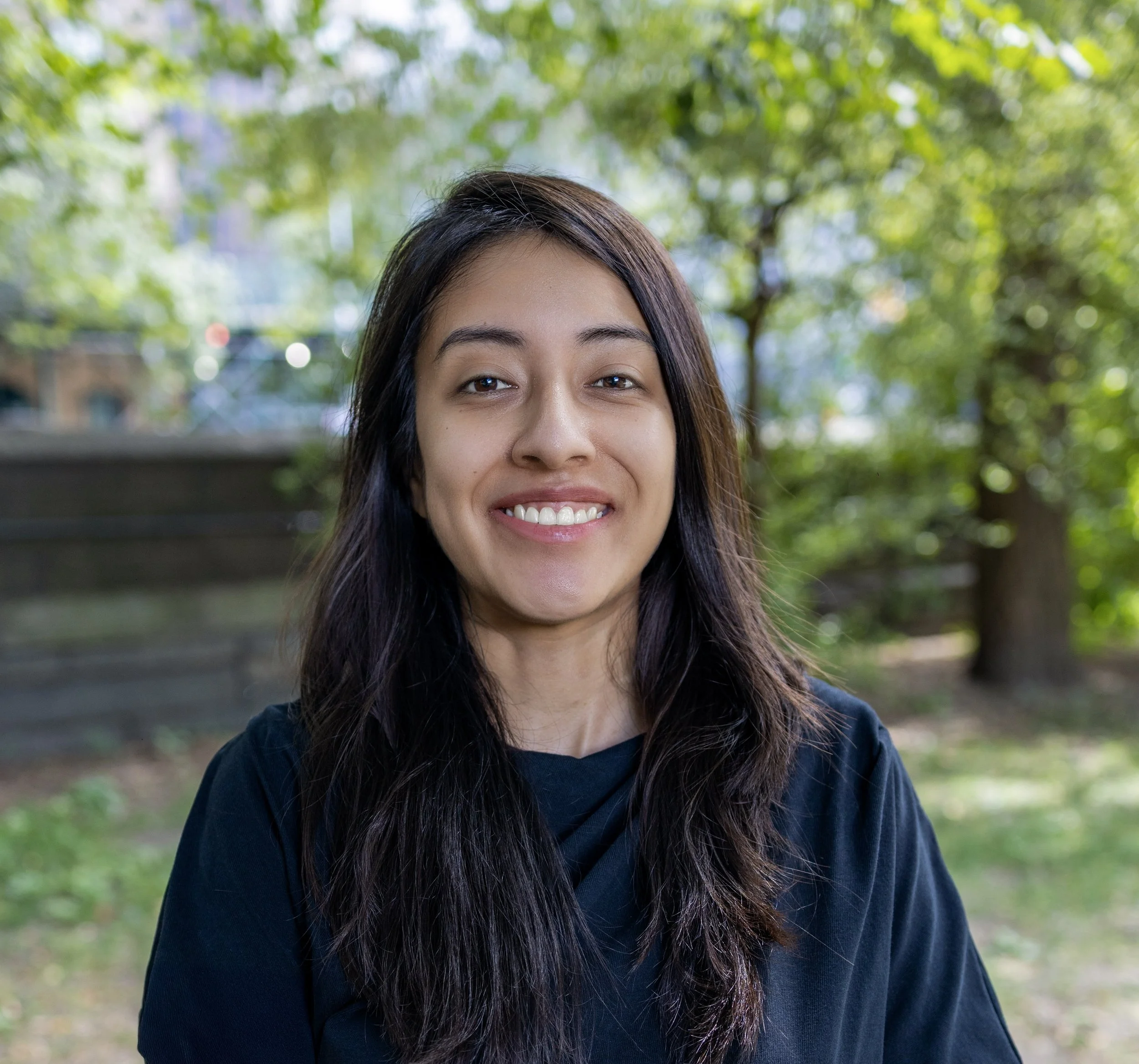
Mexican-American professional Yvonne Tapia has an extensive background in marketing, education, and media, supporting both large enterprises and small businesses. Yvonne focuses on raising brand visibility and community engagement, particularly within marginalized sectors. She is a current Senior Instructor at COOP Careers, where she mentors through hands-on marketing training while partnering with businesses from different industries. Outside of work, Yvonne is an avid reader and is involved in supportive causes.