Author Interviews

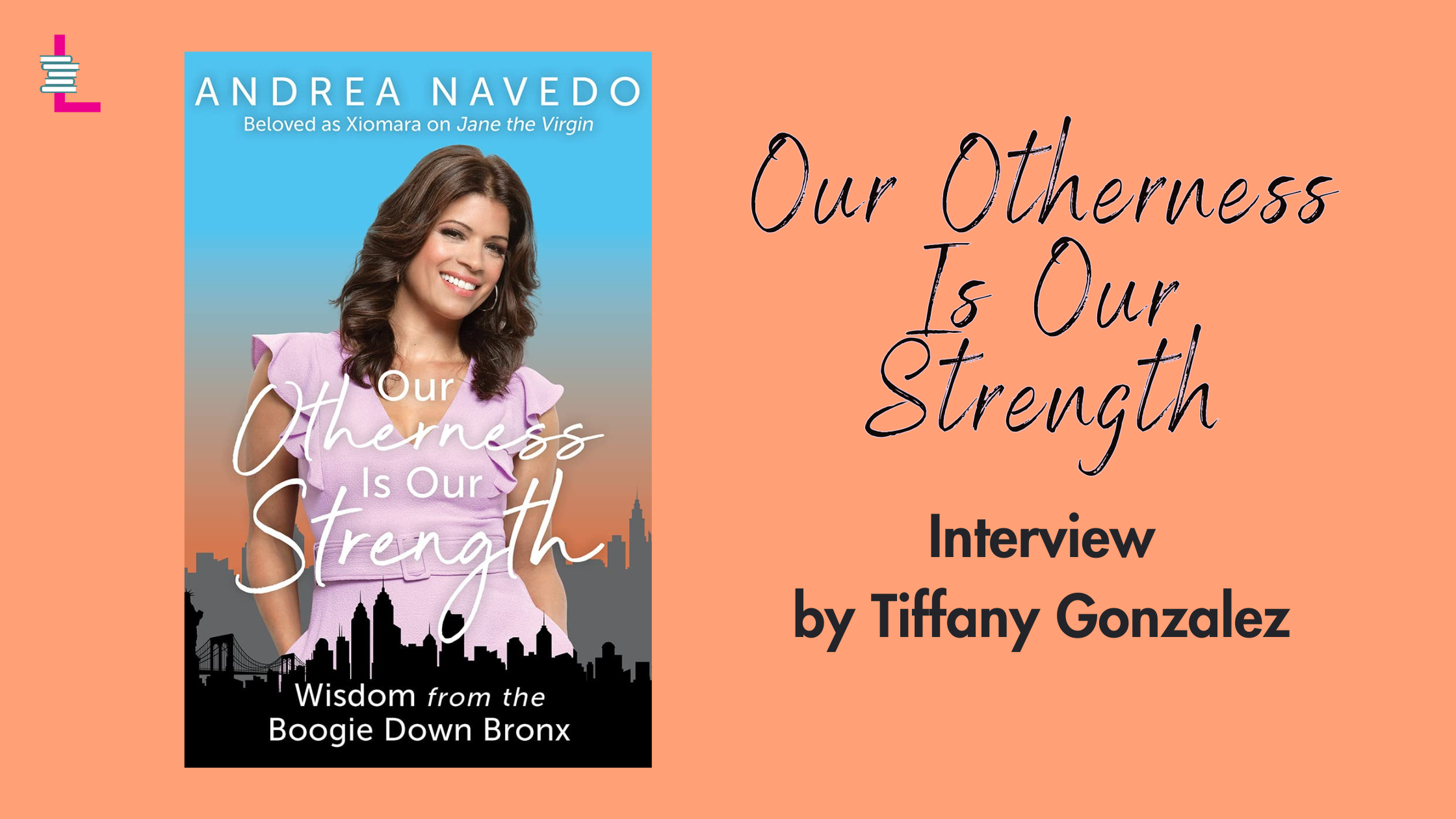
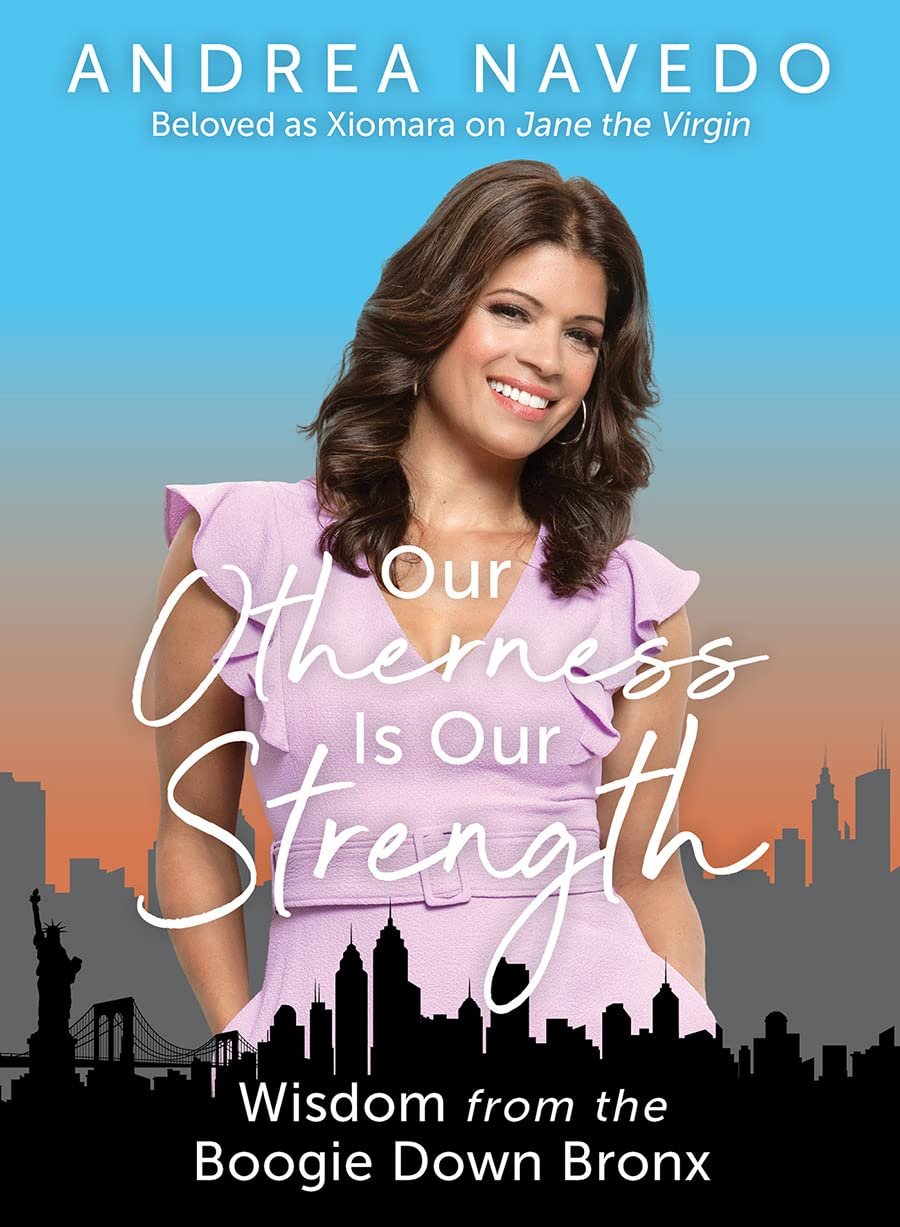
Interview: Our Otherness Is Our Strength by Andrea Navedo

In her book Our Otherness Is Our Strength: Wisdom from the Boogie Down Bronx, Andrea Navedo, known as Xiomara from the acclaimed CW series Jane the Virgin, reminds us that “When you show up for you, amazing things happen.” A short but powerful book, filled with lessons on how to thrive in our “otherness.”

Expanding on her commencement address to her former alma mater DeWitt Clinton High School as well as other speeches that she has given, Navedo proudly highlights how her upbringing in The Bronx has made her who she is today. From learning how to stand up for herself, to further exploring her culture, to becoming the representation she wished to see on television, Our Otherness Is Our Strength is an invitation from Navedo to believe in yourself.

Each chapter begins with a quote, wisdom that gets reflected throughout each unique story, and as we slowly get more intimate with Navedo, we start seeing that there’s no limitations to what one can achieve if you believe in yourself.

On behalf of Latinx in Publishing, I asked Navedo a few questions about the journey that led to writing her book, the importance of Latinx representation in the media, exploring your cultural history and more.

Tiffany Gonzalez (TG): I'm a huge Jane The Virgin fan and was excited to learn that you had a forthcoming book. I was also even more excited to learn that you were from the Bronx, as I spent my childhood there, until I was 13 years old. How did the idea for this book come into fruition. And why did you decide to focus on your upbringing and the Boogie Down?

Andrea Navedo (AN): I wrote this book because while I was on Jane the Virgin I was invited to give the commencement speech at the high school I graduated from. I had been wanting to write a book for a while. I wasn't sure what it was going to be about, but I felt like I had some ideas to share. And so when I got the invitation to give the commencement speech at Dewitt Clinton Highschool in The Bronx, I thought, Wow, here I am! It's 30 years later. What am I gonna say to these kids? I was one of those kids sitting in those seats. The response from the speech was so positive that I wanted to share what I told them, tell stories they related to, on a bigger scale. That’s where the idea for the book came from.

The other reason why I have the Bronx in the title is because when I was growing up, I felt like “the other”—one who's not part of the mainstream, not accepted. I felt that being from The Bronx was one of the things that made me “other.” Also, the reputation The Bronx has worldwide is as dangerous, a bad place. I wanted to shine a light on the humanity that is in that borough and show that good can come out of The Bronx, that wisdom can come out from there—and places like it. I wanted to focus on my upbringing to show the humanity of my community.

I may not have gotten to see myself reflected on television, but I got to be the person to help create that reflection, that image.

TG: OK, I grew up in the 90’s/2000s and watched a lot of TV in Spanish and English. It never dawned on me that no one ever looked like me until much later in life. It's one of the reasons that I love Jane the Virgin. I not only saw myself but my family in the characters. Can you talk more on why it's important for characters like Xiomara, to exist on television and your thoughts on the future of Latinx people in the media?

AN: I was aware, when I was growing up that I wasn’t being reflected on television and film. As a little girl, I had a dream of being an actress. I never shared it because it seemed like a pie-in-the-sky dream, unobtainable, especially because I didn't see my own images reflected on television—at least not in a positive way.

I’m a member of the Geena Davis Institute for Gender in Media. Her message is “If she can See it, she can Be it.” What she tries to promote are more female images in front of the camera, more female lead characters and she's also expanded that agenda to bring in more diverse characters, as well. I believe that motto is true, that if she can see it, she can be it. Unfortunately, I didn't see it. So it was really hard for me to believe that I could “be it.” I'm glad that I tried acting as a career anyway, because I got to be one of the people who have represented people like me and have created an image that could potentially inspire a younger generation of “others.” I may not have gotten to see myself reflected on television, but I got to be the person to help create that reflection, that image. That's really important to me. Jane the Virgin was the show that I needed when I was growing up. I needed that show. It would have meant so much to me. But the prize came later on for me, when I became an adult. I got to be the person to bring that gift, not only to my family, (because the women in my family didn't get to see it either) but to other generations of Latinos, people of color and a diverse background of so many cultures that related to Jane the Virgin. It is not just being Latina. That whole immigrant story makes sense to so many cultures in the United States and globally. I'm proud and happy that I got to be one of persons who helped tell that story.

TG: In the book, you discussed negative portrayals of The Bronx in the media, throughout your upbringing. Do you think those portrayals are different today? If so, how? What is something positive you wish for people to know about The Bronx?
AN: There’s definitely way more positive images of Latinos or people of color in the media now. That's because so many people have been speaking up for years, pointing out the discrepancy in the population at large versus what you see on the screen. There was a huge discrepancy there that makes a certain segment of the population feel left out, excluded, “othered.” That's really where my book comes from: feeling like “the other” but realizing that being “the other” and all the challenges that come along with that can be the very thing to help you succeed. Those challenges are what make you stronger. It made me strong enough to handle a very challenging career as an actor. Entertainment is still a very, very challenging career.

People may know that The Bronx just celebrated the 50th anniversary of Hip Hop, which was born in the Bronx! Hip Hop is a global, multibillion dollar industry. Who would have thought that those black and brown kids from the Bronx had anything to offer the world? And look at what they offered?! Hip Hop is not only for black and brown kids anymore. It's for all cultures. It has exploded. It’s been an amazing way of expressing the challenge of being “the other” through music and dance. It's resonated with so many people and so many cultures because everyone has some sort of otherness. Everyone has some challenge and hip hop is a way of saying F you to the Big System and carving a way for oneself. Another multibillion dollar influence is Salsa music. Salsa also comes from The Bronx. Many think that salsa music came from Puerto Rico or from Cuba. It has its influence from there but the birthplace of salsa music is The Bronx. But no one has to do something amazing or incredible in order to be validated. I want people to know that the people living in The Bronx or a place like The Bronx are human beings with dreams, wishes, wants, goals. These are people who care for their children, who want them to do well in the world, who want their kids to be safe and contributing members of society.

TG: I Absolutely loved the retelling of your time in Puerto Rico with your grandmother. I laughed when I read how much Sancocho you ate. I have to ask if Sancocho is still a go for you? 

AN: Ah Sancocho, I hardly ever eat because it's such a hearty stew and there's so much salt in it. I try to avoid soups because I’m watching my blood pressure. Fun, I know. . . If I'm given the opportunity, I would definitely have some as a treat, but Sancocho is so delicious and filling, I wouldn’t need to eat for the rest of the day!

. . . learning the language, learning about your history, and traveling to your country of origin, really help give you a sense of belonging.

TG: We are in a pivotal time, people are exploring their histories more, doing the research they weren’t assigned growing up, fighting back the unjust systems trying to erase our past. What is your advice to those on this crucial journey?

AN: I would say to explore your heritage, your background, what your genetic makeup is. Learn where your parents and grandparents are from, where your great grandparents are from, because it will give you a sense of identity and belonging. I needed that growing up. As a kid, I knew I was Puerto Rican, but I didn't really know what that meant. Puerto Rico was just some island far off I had never been to. It sounded cool. I was an American, although I didn't feel American because I didn't look American. I didn't look like the people on TV. I kept asking myself, “Who am I and where do I belong?” Then I had the opportunity to go for a month to Puerto Rico to stay with my grandmother and have Sancocho and roast coffee beans from the family farm out in the sun, on the patio. I had the freshest, best coffee I've ever had in my entire life. That gave me a sense of identity and belonging. Then, as an adult, I decided to learn Spanish because I did not grow up speaking Spanish. I was technically second generation in the States and so even though my parents speak Spanish, they would always speak to me in English. They grew up in a time where assimilation was the most important thing. You had to assimilate into the American culture and on some level, you had to reject your family culture. There was a lot of racism that my parents experienced, especially my mom because she had brown skin, like me. My father had fair skin, blue eyes so it was a little easier for him to navigate the world, but for my mother, it was harder. As an adult, I started to learn Spanish, especially because when on that trip to Puerto Rico, I didn't know how to speak with my extended family members. I couldn't understand them and they made a comment that it was a shame that I didn't speak Spanish. I felt very embarrassed and said, “Hell no! When I get older I'm going to learn how to speak Spanish.” So when I graduated college I went to Mexico. It was cheapest of all those Spanish abroad Programs. I had some money saved up. I went to Mexico for three months, attended a Spanish school, lived with a family who didn't speak English and I learned so much during that time. After that, I studied in Manhattan at a really cool school that doesn't use textbooks. They teach in a way that is very natural to how we learn to speak languages. I also went to Cuba for a month to the University of Havana. I’ve done all this to claim my identity because learning the language, learning about your history, and traveling to your country of origin, really help give you a sense of belonging.

Writing this book gave me the opportunity to look at where I was from and to see how far I had come.

TG: Could you share some words of wisdom to those embracing  their “Otherness?” 

AN: Write down the negative experiences or feelings you've had growing up or even in your adult life. What were the challenges your otherness created? For me, the sense of being Latina and brown from The Bronx, made me feel like I was less than, not valuable enough to be an actor or to be a featured actor. But I persevered anyway. I pushed against that, and those things made me stronger. I lived in a tough neighborhood, was bullied, but I used that to make myself stronger. Back to your list. Write down your challenges, especially those that came with your otherness. Then list the achievements in your life. So often we focus on what we didn’t get and what was bad and wrong that happened to us and never stop to say, “Well wait, look what have I overcome and achieved.” That’s what was so great about writing this book. Writing this book gave me the opportunity to look at where I was from and to see how far I had come. Those are my words of wisdom. Do that exercise and see how your otherness has strengthened you.

TG: Finally, what can we expect next from you?

AN: *The audio version of the book will be coming out very soon. I'm actually going into the studio to record the audio book, so that's what's next for me! My next goal is to work on a TED talk or two, but nothing is in stone yet. For those who’ve never heard of a TED Talk, it’s a global organization that promotes speeches to help share ideas and get the word out to millions of listeners.

*The audio is now available via audible.


Andrea Navedo is a Bronx-born-and-raised Puerto Rican American actress best known for her role as Xiomara, a complex and genuine Latina, on The CW’s series Jane the Virgin, for which she received critical acclaim. She is dedicated to various charities, including A Place Called Home in South Central Los Angeles, and the Fresh Air Fund in New York City. Navedo has a passion for self-improvement, growth, and healing, and through her experiences seeks to help those who see themselves on the outside looking in. She and her family divide their time between their homes in Toronto and Connecticut. 

Website: AndreaNavedo.com
Instagram: @andreanavedo
Facebook: /AndreaNavedoOfficial
Twitter: @andreanavedo

Tiffany Gonzalez is the Marketing Manager at Astra House and the Board Treasurer for Latinx In Publishing. She previously worked in Production at HarperCollins Publishers. She has worked on the Publicity and Marketing campaign for Dreaming of You by Melissa Lozada-Oliva and on the Marketing campaigns for Becoming Abolitionists by Derecka Purnell, National Book Award Finalist The Town of Babylon by Alejandro Varela and Y/N by Esther Yi. She was a 2022 Publishers Weekly Rising Star Honoree. She has earned her Bachelors and Master's degrees from Rutgers University - New Brunswick. She is Dominican-American and fluid in Spanish. You can follow her on Instagram @wandering_tiff_ and on Twitter @wanderingtiff or visit her website wanderingtiff.com.

Margarita Engle and Olivia Sua On Bringing Water Day To Readers

Water days are special days for a young girl in Trinidad—a town in central Cuba. They hold great significance for her whole village, actually.

On this particular water day, the girl joins her mami on a mission to mend their family’s leaky hose.

By the time the water man
finally arrives, we’ll be ready to fill
the blue tank on our flat red roof
with clear water
that flows
like hope
for my whole
thirsty familia.

Newbery Honor Award-winning author Margarita Engle brings readers Water Day—a celebratory picture book about the arrival of the water man to a small village. The book (out now from Atheneum Books for Young Readers) was illustrated by Olivia Sua.

The village in Water Day no longer has its own water supply. So residents rely on the water man, who visits weekly to distribute water to them. This time, he arrives in a wagon pulled by a horse that strains against the weight of a metal tank. Through the eyes of the book’s young narrator, readers are pulled into the anticipation of this day and, most importantly, what it means to have access to water.

“This story is really the contrast between how easy it is to get a drink of water in so many places, and how difficult it is in so many other places,” Engle told Latinx in Publishing. “And I’m not going to say that it’s just the U.S. against developing countries, because I live in a part of California where a lot of my neighbors’ wells have gone dry. And we don’t have access to city water because we’re in a rural residential zone. So if our wells go dry, that’s it. We have to do exactly what’s shown in this book, which is [to] bring water in a tanker truck.”

Engle was born in Los Angeles but spent many childhood summers with family in her mother’s hometown of Trinidad de Cuba. The author said she featured a horse and wagon for water transport in her book because, in Cuba, there’s a fuel shortage which causes horses to be used in some areas to bring water to people.

The joyous tone of Water Day is not only a credit to Engle’s lyrical style of writing, but also to Sua’s gorgeous illustrations. Sua’s art form of mostly painted cut paper breathes life into the book—bringing readers closer to Cuba and its people. There are also colorful houses with intricate iron window bars. There is a kitchen with hanging pots. A mango tree. There are mountain landscapes behind homes and churches. And even tinajones—big clay jars that the narrator’s great-grandmother says used to be filled with daily afternoon rains.

“This is probably one of the most research-intensive books I’ve ever done because I was trying to capture Trinidad,” Sua said. “I wanted to get the essence right.”

Though Water Day doesn’t explicitly say the story is set in Cuba, Engle confirmed it is.

Sua said she conducted a lot of research on Cuba through Google Maps and through photos of the country online. She also received input from Engle.

The illustrator said the story’s themes of environmentalism and the climate crisis first drew her to Engle’s manuscript. They are topics she cares deeply about.

Readers of Water Day may feel a jolt of realization as to just how important water is in their everyday lives. This is succinctly described in the below lines from the book:

Five days have passed 
since the water man’s last visit.

We need to bathe,
wash clothes, 
cook rice…

Engle didn’t hesitate when asked if that was intentional on her part.

“Yes, absolutely,” the author said. “We take water for granted. . . There’s a lot of injustice all over the world. It’s not just Cuba. It’s not just certain societies. There’s just this injustice in terms of access to water, and it’s so basic. This is something that everybody needs, but we don’t have equal access.”

Sua said Water Day is an important story. “Some of us are experiencing flooding,” the illustrator said, “and some of us are experiencing water scarcity.”

Engle has written many verse novels, memoirs, and picture books throughout her publishing career. For this book, she wanted to tell the story from the point of view of a child without scaring readers or making them sad.

“I actually wanted to focus on the joy of the arrival of the water, rather than on those days in between when you don’t have it being delivered,” the award-winning poet said. “I wanted to focus on the excitement of just what it means to finally have water.”

In her author’s note, Engle wrote about her mother’s hometown of Trinidad and how water access has become a lot more complicated due to factors such as climate change, polluted groundwater, and crumbling pipes for delivery. She told Latinx in Publishing that, when searching online for photos of the rooftops in Trinidad, you’ll see the blue tanks of water. You would not have seen that a few years ago, Engle added, “because everybody was able to get enough water from wells and so forth.”

She wants children to think about how privileged they are when they do have running water.

“I want to say we’re wealthy if we have that, but it’s a different kind of wealth because there are areas where middle-class people in the U.S. don’t have access to clean water,” Engle said. “So it’s just something to not take for granted. We need to treasure our natural resources.”


Margarita Engle is the Cuban American author of many books including the verse novels Rima’s Rebellion; Your Heart, My Sky; With a Star in My Hand; The Surrender Tree, a Newbery Honor winner; and The Lightning Dreamer. Her verse memoirs include Soaring Earth and Enchanted Air, which received the Pura Belpré Award, a Walter Dean Myers Award Honor, and was a finalist for the YALSA Award for Excellence in Nonfiction, among others. Her picture books include Drum Dream Girl, Dancing Hands, and The Flying Girl. Visit her at MargaritaEngle.com.

Olivia Sua is an artist who creates elaborate works of painted cut paper. She is from Washington State and resides in her hometown of North Bend. In 2020, Olivia graduated from Pacific Northwest College of Art with a BFA in illustration. When she’s not illustrating, Olivia likes to go backpacking, quilt, and collect seeds for her garden. Visit her at oliviasua.com.
Amaris Castillo is an award-winning journalist, writer, and the creator of Bodega Stories, a series featuring real stories from the corner store. Her writing has appeared in La Galería Magazine, Aster(ix) Journal, Spanglish Voces, PALABRITAS, Dominican Moms Be Like… (part of the Dominican Writers Association’s #DWACuenticos chapbook series), and most recently Quislaona: A Dominican Fantasy Anthology and Sana, Sana: Latinx Pain and Radical Visions for Healing and Justice. Her short story, “El Don,” was a prize finalist for the 2022 Elizabeth Nunez Caribbean-American Writers’ Prize by the Brooklyn Caribbean Literary Festival. She is a proud member of Latinx in Publishing’s Writers Mentorship Class of 2023 and lives in Florida with her family and dog, Brooklyn.

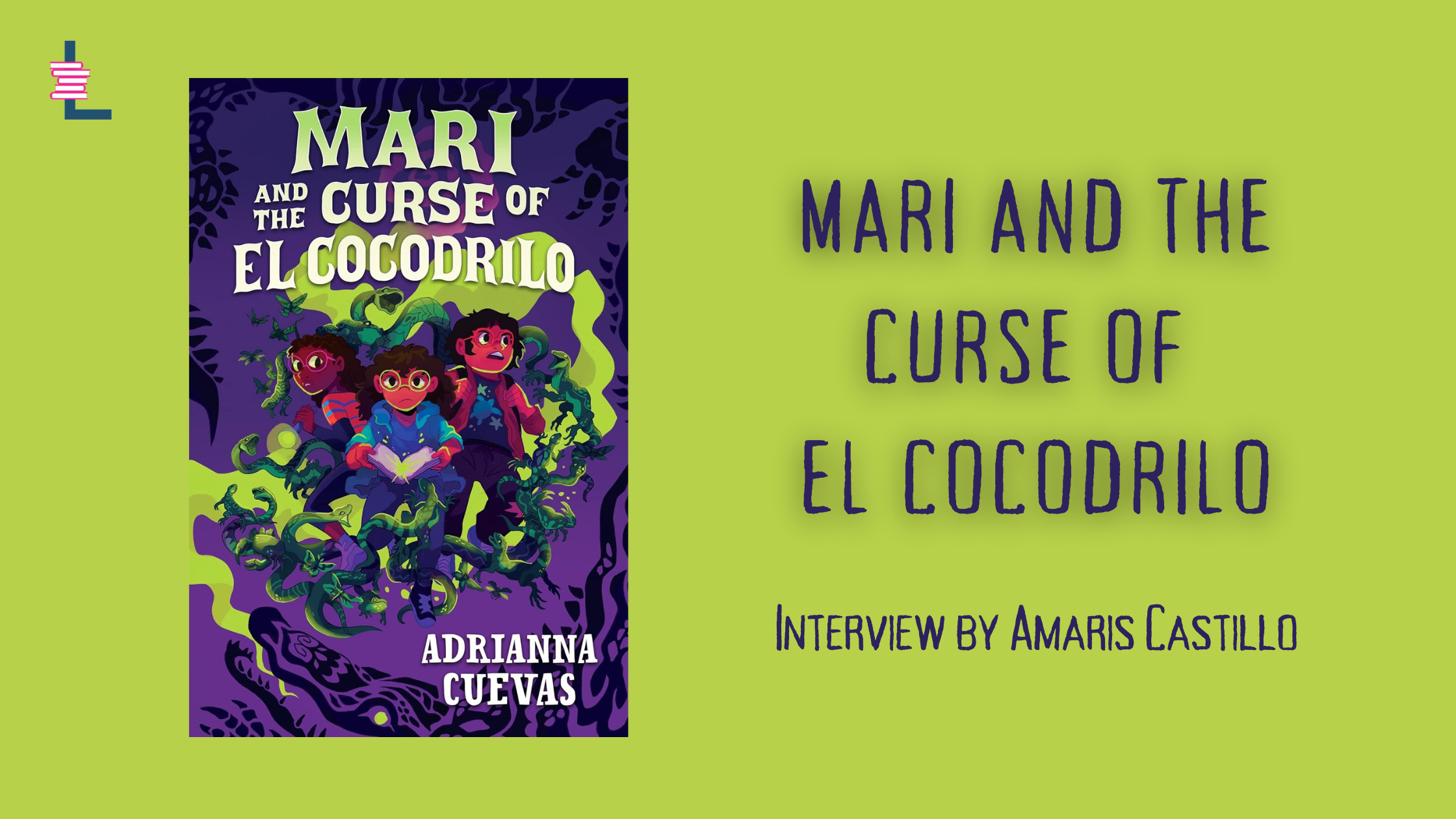
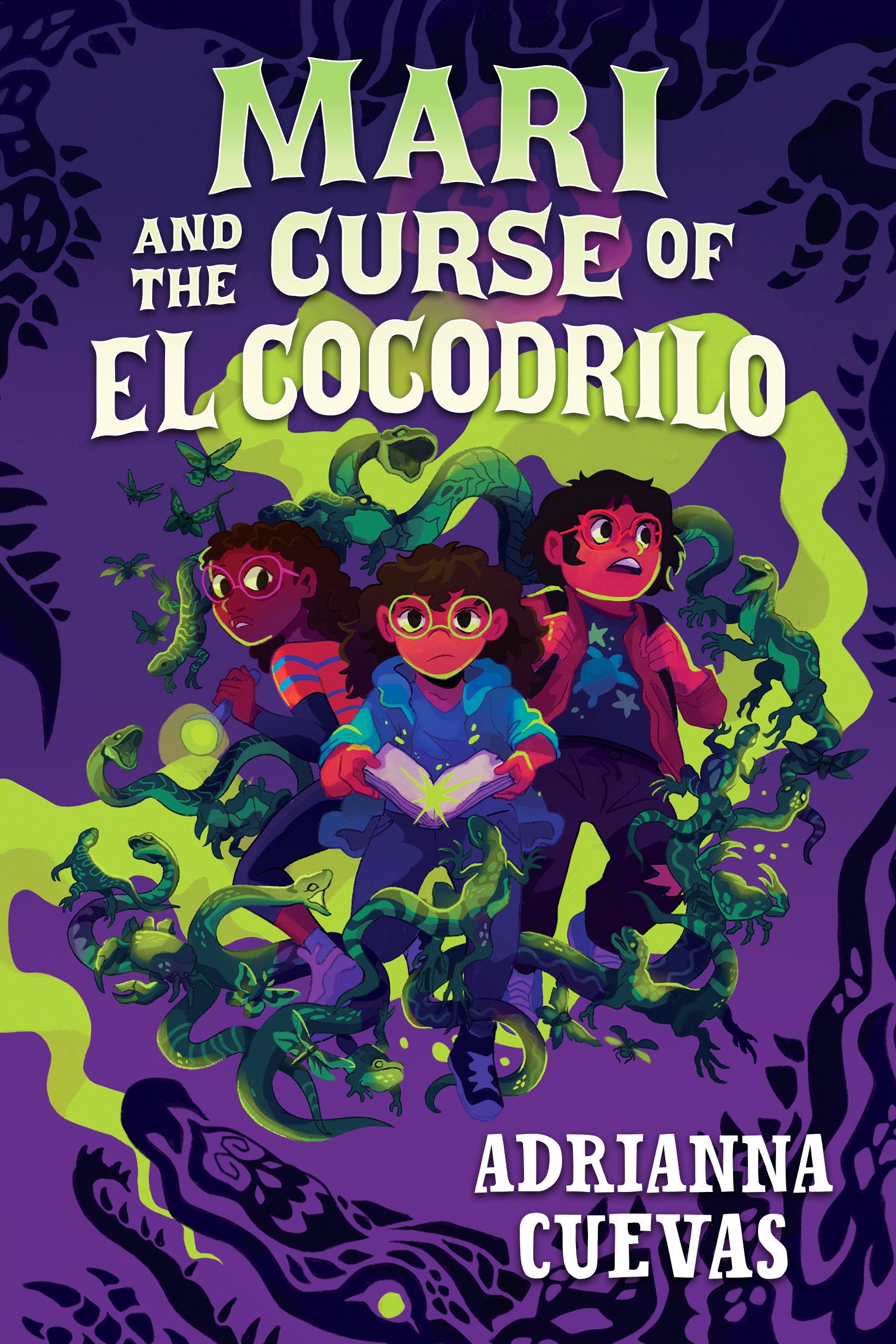
Author Q & A: Mari and the Curse of El Cocodrilo by Adrianna Cuevas

When 12-year-old Maricela Yanet Feijoo isn’t at school or with her best friends, Keisha and Juan Carlos, she can sometimes be found wincing at what she calls her family’s “Peak Cubanity.” She also worries that her next-door neighbor and classmate—who she calls “Mocosa” Mykenzye—will judge.

“Peak Cubanity” is what Mari calls her family’s behavior when she feels they’re being over-the-top. And she’s got many examples from which to draw from on New Year’s Eve because that’s when she says they reach Peak Cubanity. It’s the day Abuelita lugs a suitcase around the block because she wants to travel the upcoming year. And Mami sweeps and mops the whole house, leaving a bucket of dirty water by the front door, so that she can throw it out at midnight.

“At least we won’t be eating twelve grapes at midnight as fast as we can,” Mari narrates. “When I almost choked last year, Papi had to do the Heimlich maneuver on me and everything. I shot a green grape straight out of my throat and into the eye of my sister, Liset. Maybe something that’s supposed to bring you good luck shouldn’t also try to kill you. Just a thought.”

Cuevas brings readers another memorable story that will both make you chuckle and feel deeply for a young girl finding her place on her family tree.

Which is why at the start of Adrianna Cuevas’ new middle grade novel, Mari and the Curse of El Cocodrilo, the titular character declines to participate in her family’s biggest New Year’s Eve traditions: burning an effigy to rid themselves of the past year’s bad luck. But after Mari fails to throw hers into the fire, strange things begin happening. Bad luck falls upon her, then spreads to her friend, Keisha.

Out now from HarperCollins, Mari and the Curse of El Cocodrilo is a heartfelt and humorous story about one girl’s journey toward self-acceptance and learning how important it is to know your family’s history. Spooky vibes and silliness also permeate the book, as readers witness all kinds of things happening to Mari. Among them are uncooperative pencils during a quiz, a possessed violin and, in Keisha’s case, shoes that glue to the mat when she’s at fencing practice.

Once Mari discovers she has a unique ability to call upon her Cuban ancestors, she and her friends embark on a quest to work with the ghosts to try to defeat El Cocodrilo. Can they do it?

In Mari and the Curse of El Cocodrilo Cuevas brings readers another memorable story that will both make you chuckle and feel deeply for a young girl finding her place on her family tree. The Pura Belpré Honor-winning author spoke with Latinx in Publishing about crafting Mari’s story, preserving your family’s history, and more.

This interview has been edited for clarity and brevity.

Amaris Castillo (AC): Congratulations on Mari and the Curse of El Cocodrilo! What inspired this story?

Adrianna Cuevas (AC): This story really came from a couple of avenues. First, I’m a horror fan. I’ve always loved horror. My dad took me to see Alien 3 when I was a kid in the theater, probably way younger than a child should have been seeing Alien 3 in the theater. That is a core memory for me. Part of it was this is my fourth published book now, and I’ve been writing mostly adventure. I was a little bit spookier with The Ghosts of Rancho Espanto, but I really wanted to dip my toe more into spookier stories for middle grade kids.

The emotional inspiration really comes from my own experiences, and different students that I’ve interacted with; those second and third generation kids who are trying to figure out how their parents’ culture and their grandparents’ culture still fits into their lives. Because I think sometimes you can feel a little bit more disconnected from it.

For me, growing up I didn’t hear about a lot of the experiences of my family when they were in Cuba. They didn’t talk about them. One of the reasons I wrote Cuba in My Pocket was because I wanted to hear those stories. A lot of times there’s kind of a disconnect, where you don’t have all the family history that a lot of other families do. My husband’s family is from rural Oklahoma and when his grandfather passed away, they had this shed full of all this stuff from generations and generations past that was connected to their family history. Everything had a story. And I thought, I don’t have anything like that. I have things from my dad, but they’re all from things once he moved to the U.S. I have one small jewelry box that my grandmother actually wrote on the inside, “I brought this from Cuba.” That is literally the only thing.

So that’s a long-winded answer to say I was drawing from my own experience of kids that feel like they’re wanting that connection, perhaps—or maybe they don’t—with their family’s culture. But they’re not quite sure how that works. Then, of course, I wanted to throw in some horror just to make it fun—because I can never help that.

AC: Your main character, Maricela—or Mari—cringes at how extra her Cuban family can be. She even has a term for it: Peak Cubanity. It reminded me of how some first generation Americans struggle at times to straddle two cultures—that of the United States and of the country their parents hail from. What was it like crafting this character who, from the first page, seems to shun her family’s culture at first?

AC: A lot of it was not entirely based on my own experiences, but drawn from them. I grew up in Miami, Florida. Growing up Cuban in Miami, Florida, is a super privileged thing to do in all honesty, because your culture is everywhere. Our music is on the radio. You have your choice of Cuban restaurants to visit. You would go out and do all your errands for the day, and never have to speak English once.

I did not feel that sense of ‘other’ until I went to college in Missouri, because that was my first time being away from an area where, in all honesty, my culture was the majority. And so I got that sense that Mari does, of ‘Well, who am I and how do I fit in? And everyone here assumes that I’m Mexican because I speak Spanish.’ That happened to me a ton. It especially happens to me here in Texas. And so I wanted to honor those kids who feel the same way. I mean, Mari loves her family. But what child of any cultural background is not embarrassed by their family ever so often?

I wanted Mari to experience the joy that you can get from learning your family’s history, but at the same time understanding maybe why you didn’t know all about it to begin with. Because a lot of it can be painful. That happened when I was researching Cuba in My Pocket. I’m asking my dad and my cousins, as well, of their experiences in Cuba and coming over to the U.S. And not all the stories are great. You can see why maybe kids don’t hear everything, and adults are reluctant to talk about it. A lot of it was drawn from my personal experiences. But if you’ve ever met Cubans, the “Peak Cubanity” fits because we are not a subtle people. And so I had a lot of fun just writing the joy and the extra that Mari’s family is.

AC: Your book is so lively with all the bad luck shenanigans that happen to Mari and, later, her friend, Kiesha. How did you come up with all the bad luck instances that happen? That was so fun to read.

AC: I will say that coming up with nonsense or just off-the-wall things is not hard for me when I am living with a now 16-year-old. Neither he—as my son—nor I have any filters. We tend to bounce really silly ideas off of each other all the time. I think as a creative person, it is really important to have someone like that in your life who doesn’t edit your creativity. They encourage you.

In all honesty, I’ve gotten into the habit where, if an idea pops into my head—even if it’s really off-the-wall—I’m not self-editing right away. I think that happens to a lot of authors, where you come up with an idea and the very next spot is, ‘Oh, no, that’s dumb. Nobody’s gonna want to read that.’ Because I have people in my life—my husband, my son—who are always encouraging my ideas and helping me brainstorm even the most nonsensical thing, I really value that as somebody in a creative profession.

It’s not hard to think of off-the-wall things when you’re just kind of letting your brain go. I always joke that as a Cuban, it’s very easy to write horror. It’s very easy to write a character that’s been cursed with bad luck. By and large, because of our political history, Cubans tend to be pessimists in all honesty. They’re gonna look at a situation and pretty much assume the worst is going to happen. That’s the whole function of horror, is asking, ‘What’s the worst that could happen?’ And so I feel like I was at a cultural advantage, thinking: ‘Well, what’s the worst that can happen to Mari in this situation?’

AC: You’re like, ‘I got this. I’m Cuban.’

AC: Exactly. Like, I was already being a pessimist about this situation. I knew what was going to happen.

AC: There’s another storyline here about the importance of documenting the stories and memories of family members who are deceased. What message were you hoping to send by highlighting this?

AC: I realize that for each of my books, it’s really my way of hanging on to something that I think is important, and that I think needs to be remembered. . . In Mari’s story, it’s my way of showing that, ‘This is why that’s important. We’re not going to have all these people around forever.’ You know, Mari only gets a lot of the stories from ghosts. We can’t let that be our option, where we’ve waited too long to preserve our family’s history.

One of the things that I am passionate about is the ability to tell our own stories, before someone else tells them for us. We need to remember and commemorate what’s happened to us before somebody else decides to tell our own history. And so I think that’s something I’m pretty passionate about because it’s now come up in pretty much every single manuscript I’ve written. I always have the adventure plot, the horror, the silliness, whatever—but the emotional core of all my stories is always going to come from something that I feel is important to remember. I think that’s why I addressed the story the way I did.

AC: What are you hoping readers take away from Mari and the Curse of El Cocodrilo?

AC: I never go into writing any of my books with a lesson in mind. Because, for me, I want young readers to dive into one of my books. I want them to lose track of time. I want them to forget where they are, and I want them to just enjoy a story. That’s my primary goal with every single one of my books.

With Mari though, it would make me pretty happy if it made a young reader curious about their own family’s histories, start asking their elders some questions, or asking to be told stories. But by and large, I’m always just wanting my readers to have fun with my books.


Adrianna Cuevas is the author of the Pura Belpre honor book The Total Eclipse of Nestor Lopez, Cuba in My Pocket, The Ghosts of Rancho Espanto, Mari and the Curse of El Cocodrilo, and Monster High: A Fright to Remember. She is a first-generation Cuban-American originally from Miami, Florida. A former Spanish and ESOL teacher, Adrianna currently resides outside of Austin, Texas with her husband and son. When not working with TOEFL students, wrangling multiple pets including an axolotl, and practicing fencing with her son, she is writing her next middle grade novel.

Amaris Castillo is an award-winning journalist, writer, and the creator of Bodega Stories, a series featuring real stories from the corner store. Her writing has appeared in La Galería Magazine, Aster(ix) Journal, Spanglish Voces, PALABRITAS, Dominican Moms Be Like… (part of the Dominican Writers Association’s #DWACuenticos chapbook series), and most recently Quislaona: A Dominican Fantasy Anthology and Sana, Sana: Latinx Pain and Radical Visions for Healing and Justice. Her short story, “El Don,” was a prize finalist for the 2022 Elizabeth Nunez Caribbean-American Writers’ Prize by the Brooklyn Caribbean Literary Festival. She is a proud member of Latinx in Publishing’s Writers Mentorship Class of 2023 and lives in Florida with her family and dog, Brooklyn.

Andrea Beatriz Arango on Found Family in Something Like Home

Something Like Home opens to a dreaded ride. Laura Rodríguez Colón is in the backseat of her caseworker Janet’s car. They’re headed to Laura’s new (temporary) home. When they reach Titi Silvia’s apartment, Laura stares at a woman she doesn’t recognize nor has ever had a relationship with.

The sixth-grader doesn’t understand why she has a caseworker, or what a caseworker even does. Still, Laura floods Janet with questions. Below are a few:

How long will I be with my aunt?
What will happen to our trailer?
What will happen to the things I don’t pack?
When can I talk to Mom?
When can I talk to Dad?
What does kinship care mean?

Laura wonders if the 911 call she made is what caused her to be separated from her parents. She wonders if this is all her fault.

Another day, while on a walk, Laura finds a dog. The big brown puppy looks sickly, and so she carries the dog all the way to Titi Silvia’s house. She names him Sparrow.

Andrea Beatriz Arango, the Newbery Honor Award-winning author of Iveliz Explains It All, has brought forth a moving middle grade novel-in-verse about a young girl on a journey to understand what home means, and what makes up a family. Readers witness Laura navigate a strange reality—a new place to rest her head at night, a new school, and a budding new friendship—all without her parents.

After taking in Sparrow, Laura also finds a newfound purpose. She believes that if she trains him to become a therapy dog, then perhaps she’ll be allowed to visit her mom and dad. Perhaps, then, she could move back in with them and their family would be made whole again.

But, of course, it is not that easy.

“I’m a firm believer in that community can look like a lot of different things,” Arango told Latinx in Publishing. “Family can look like a lot of different things.”

Something Like Home was inspired by the author’s time as a foster mom in both her native Puerto Rico and in Virginia, where she most recently lived. Arango said that a lot of children—even those who aren’t in foster care but come from big families—are asked to choose one family member over another, or to take sides in an argument.

“I think it’s really hard as a kid to feel like you have to choose, and you can’t have more than one thing,” Arango said. “I really wanted to explore that in this particular scenario, in a non-traditional home situation, or just in general that idea that you can have more than one home, and you can have more than one family. And loving one of them does not cancel out the other. You don’t have to pledge your loyalty to only one person, or one home.”

It’s something Laura struggles with at first.

“She feels that it’s a betrayal of her parents if she starts growing her bond with her aunt or that, by loving her aunt, she’s loving her parents less,” Arango said. “And that’s definitely not the case.”

Because Laura is 11, her voice feels a bit younger than what readers are used to in the middle grade genre. She struggles through feelings of guilt and a deep longing for her parents—through verse and in letters she writes to her parents. Arango impresses in her crafting of Laura’s letters. They contain hope, desperation, and optimism. They are heart-rendering.

“With Laura, you have someone who doubts herself all the time, and who thinks things are the way they are because she’s making bad choices. And that she doesn’t have the capacity to be in control of her own life and to make correct choices,” Arango said. “I think a lot of kids do feel that way. And part of the reason behind that is because we—as adults and caregivers and teachers—sometimes unintentionally reinforce that belief in kids over and over.”

The presence and memories associated with Laura’s parents looms over the entire book, heightening the stakes for a daughter in yearning. Readers will find themselves wishing they would write her back soon.

Arango covers several themes in her sophomore book with ample tenderness: identity, addiction, the nuances of kinship care, and even the self-blame children exercise when in pain. The author’s writing is both intimate and accessible, as readers are taking on an emotional rollercoaster with Laura as she both learns and unlearns different aspects of the very nature of family.

The author recalled having foster children as students in her classroom when she was a teacher, and the scarcity of what she described as nuanced foster care books. The majority of the books she found painted the parents as evil, and as social services as a rescuer of the child from a horrifying situation.

“Obviously that is the case for some children. We do have abusers in society who did terrible things to their kids,” Arango said. “But the majority of foster care cases in the U.S. are not abuse cases.”

The author’s writing is both intimate and accessible, as readers are taking on an emotional rollercoaster with Laura as she both learns and unlearns different aspects of the very nature of family.

Most of the cases, said Arango, are classified as neglect. Reasons that can lead to a child being removed from the home include a family’s financial or housing situation, or parents losing their jobs or having an addiction.

“I wanted to write a book that looked at it in a more nuanced way. Laura loves her parents. Her parents love her,” Arango said. “They’re not bad people. They—just like a lot of people in the U.S.—became addicted to a substance. . . That happens a lot.”

Of note in Something Like Home is Sparrow and how important his role is in Laura’s new life. Arango is a self-described “dog person,” and shared that one of her dogs was the inspiration for the fictional dog. The author said she’s interacted with therapy dogs in different scenarios and wanted to highlight them in part to raise more awareness about them for young readers. The author added that she also wanted her main character to have a project she could focus on.

“During the book, she (Laura) definitely is feeling very lost. And one of the things that makes her feel like she is doing something to help herself and her family is this training-Sparrow-kind-of-project,” Arango said. “It gives her something to work towards and it helps her not feel as helpless because she now has a plan to reunite with her family.”

At the core of Something Like Home is a lesson on found family. Arango said she hopes young readers come away with a greater awareness of foster families and kinship families.

“It’s guaranteed in most schools, there will be at least one kid per classroom who is either in foster care or kinship care, has been at some point, or has a relative who has,” the author said.

This is really common, she added.

“I wanted both for kids who are going through a situation similar to that, to feel understood and listened to and represented,” Arango said. “But also for all the kids who have never encountered it in their lives, to have a little bit more empathy moving forward in the future.”


Andrea Beatriz Arango is the Newbery Honor Award-winning author of Iveliz Explains It All. She was born and raised in Puerto Rico, and is a former public school teacher with almost a decade of teaching experience. Andrea now writes the types of children’s books she wishes students had more access to. She balances her life in Virginia with trips home to see her family and eat lots of tostones de pana. When she’s not busy writing, you can find her enjoying nature in the nearest forest or body of water.

Amaris Castillo is an award-winning journalist, writer, and the creator of Bodega Stories, a series featuring real stories from the corner store. Her writing has appeared in La Galería Magazine, Aster(ix) Journal, Spanglish Voces, PALABRITAS, Dominican Moms Be Like… (part of the Dominican Writers Association’s #DWACuenticos chapbook series), and most recently Quislaona: A Dominican Fantasy Anthology and Sana, Sana: Latinx Pain and Radical Visions for Healing and Justice. Her short story, “El Don,” was a prize finalist for the 2022 Elizabeth Nunez Caribbean-American Writers’ Prize by the Brooklyn Caribbean Literary Festival. She is a proud member of Latinx in Publishing’s Writers Mentorship Class of 2023 and lives in Florida with her family and dog, Brooklyn.

Review and Author/Illustrator Q & A: Cool Green: Amazing, Remarkable Trees by Lulu Delacre

Cool Green: Amazing, Remarkable Trees begins with a question.

“¿Por qué, abuelo? Why?”

A young girl asks her grandfather why he’s in awe of trees. He’s a landscaper who believes trees are astounding. He begins to share why.

There’s the General Sherman, considered the “world’s biggest clean air machine,” and the monkey puzzle—“a living fossil and cousin of trees from long ago.” And there’s the coconut palm, which author-illustrator Lulu Delacre wanted to include because it was a big part of her upbringing in Puerto Rico.

Out now by Candlewick Press, Cool Green: Amazing, Remarkable Trees is a tender and lyrical ode to the trees of the world, with a strong backbone in research. With each page, the Latino landscaper guides readers through the wonders of a select group of trees. We learn about the umbrella thorn acacia, which “dresses its branches with needles and hooks,” and we take in the baobab—“an upside-down tree with a trunk like a sponge.”

Delacre’s illustrations, like the trees she features, brim with life. For this particular book, she opted for a mixed media—embedding live specimens like seeds, fronds, and leaves, into the art. Once she was done with the pages, the publisher photographed it in such a way that readers can see shadows on the page from the specimens. The art as a whole will likely nurture greater curiosity about the world’s trees.

By the end of the book, readers are left with more knowledge about trees and the uniqueness each brings. It’s also humbling to learn that more than seventy-three thousand species of trees inhabit Earth. Cool Green: Amazing, Remarkable Trees only scratches the surface, but it’s a quality introduction for both readers of all ages.

The root of this book is a love for nature and learning. Delacre, a big nature lover herself, dedicated it to the young stewards of the Earth.

On behalf of Latinx In Publishing, I spoke with Delacre recently about the inspiration behind Cool Green, her research and illustration processes, and more.

By the end of the book, readers are left with more knowledge about trees and the uniqueness each brings. It’s also humbling to learn that more than seventy-three thousand species of trees inhabit Earth.

This interview has been edited for clarity and brevity.

Amaris Castillo (AC): Congratulations on the publication of Cool Green: Amazing, Remarkable Trees. What inspired you to write and illustrate this story?

Lulu Delacre (LD): It goes back to 2019, when I first saw an exhibit on trees, and specifically on the symbiotic nature between fungi and trees. That, paired with the fact that I’ve loved trees all my life. It’s a place of peace for me—walking in the woods and working in the garden.

So all the love of nature, paired with that exhibit and a love of learning—because I absolutely adore to learn—gave way to what happened next. I saw this exhibit in 2019, and then in 2020 we were on lockdown. My safe place again became walking the woods of national parks, gardening, and research. I also noticed how essential workers were thanked and how, all of a sudden, they became visible. I noticed that some people who worked in essential jobs know much more than what you think they do. That’s what made me appear the Latino landscaper who knows a lot more than what you would expect somebody that comes in and does work in your lawn might know. I wanted to share with children my awe of trees, through the voice of this landscaper.

AC: In your book, this Latino landscaper teaches his granddaughter about the different kinds of trees all over the world. Can you talk about your decision to make him a landscaper? Why was that important?

LD: For me it was important that the grandfather is a landscaper, because I have always admired the work of Latinos that come (here). . . When I had this home that I needed to take care of, I did have the help of someone who worked for me. He did the basic lawn care for many years. Talking to him, I realized that he knew so much more than what was apparent. I wanted to showcase that to children, because sometimes a reader might dismiss these essential workers. They might dismiss these people, and I feel that, that is an incorrect way of seeing life, because all of us have something to contribute to society.

A landscaper may not have the degree that a professor may have, but at the same time his knowledge is in the knowledge of the land, in the knowledge of plants, in the knowledge that perhaps came in ways that are not taught in the classroom—that are taught by nature itself. And that is valid knowledge, too.

AC: Your text in Cool Green is both poetic and informative. What was it like to balance both in order to tell a compelling ode to trees?

LD: That’s a great question. First and foremost is research, which I adore. And I did tons of it. Because I wanted the young reader to fall in love with these trees, I searched for what I call the “cool facts.” I literally made a list. If I were looking at these as a young reader, what facts would I find really interesting? What is it that I find cool about this tree? And that’s what I wrote.

After I had all my facts, then I went back and tried to weave these facts in a way that was lyrical. For me, it’s a succinct way of saying a very important thing in very few words that perhaps has more of a chance to stay in the young brain because it’s short. Perhaps it has a way of telling him, or her, or they, just enough that they feel compelled to turn the pages and find more about this specific tree.

AC: In your notes at the end of the book, you write that there are more than seventy-three thousand species of trees that inhabit the Earth. How did you decide which ones you wanted to feature in Cool Green, like the monkey puzzle or the coconut palm?

LD: I’m sorry, but I found out about the coconut palm as soon as I could because I wanted to somehow feature it. It was so much part of my upbringing, and knowing that it was the second largest seed, I said ‘OK, this is the fact. I’m not going to go with the largest seed. It’s going to be the second one, because I want to feature the coconut palm.’ Besides, it has a lot of uses.

For some young children, it’s about the champion tree—the tallest tree, or the tree with the largest girth, like the Ahuehuete from Mexico. This is a champion tree that takes literally 17 adults holding hands to go around its girth. So I wanted to have the champion trees, as well as some amazing trees that I didn’t know about until I started doing the research. Like the Eucalyptus deglupta—the rainbow gum—which literally seems that it couldn’t exist. I do sessions about this book to kids and, when I show them the illustration of the rainbow gum, I ask them, “Do you think that this tree is real, or do you think I made up those colors?” Of course, many of them think that it’s all made up. So I show them photos, and the kids are amazed.

My vision was not only to showcase trees that kids could relate to, but also to do it in a global fashion. I wanted to show readers that you have these amazing trees all around the globe. You have to be in awe. You may have one that is right in your backyard, and you don’t know that it’s there.

AC: I understand that, as part of creating the illustrations, you searched for live specimens of trees. Can you share more about your process?

LD: It’s a mixed media. You can go to my site and see some of the pictures of the process. I used soft acrylics for flat colors. I decided to blend graphic shapes with accurate height and girth of specimens. I represented the surrounding animal life to hint of tree size scale. In an echo of scientific observation I collected on my own, or sought from arboretums, leaves, twigs, cones, bark, and flowers of each species. I used some of the collected specimens to create textured hand printed papers. Finally, I selected a few chosen specimens to adhere to the art. It’s my own way of modeling for readers to do the same with trees they particularly like.

Then after everything was done, the publisher did a very good job of photographing it in such a way that you can see those shadows. So when I show the book to young people, I ask them, “Where is the specimen—the dry leaf that I collaged?” They can pinpoint it. That part was very well done by the publisher. It’s a whole process. Art for a book like this takes me about six months.

AC: What are you hoping young readers take away from Cool Green?

LD: My hope is that, by reading one of these poems, they feel compelled to know more about the specific tree that spoke to them. That it instills in them a little bit of awe for trees, and for what they do for us, humans and the Earth. Maybe they can also become collectors of specific leaves of their favorite trees. They might also be compelled to write their own poem based on facts about the tree that they particularly love.

Doing these books, for me, is like sowing seeds. You don’t know what is going to speak to a child and young minds are really where you want to sow these seeds. If you want to create stewards of the Earth, you must start with the youngest of children. Sometimes it’s just by picking up a book like Cool Green or Verde Fresco, reading a couple of pages and just telling your kid, “You know what? Let’s go out to the park nearby. Let’s go check the trees out there. Let’s see if we can find those leaves, and then let’s see if we can find oak leaves. And what kind of oak leaves do you see?” It’s a bridge to asking questions. And kids are just so curious. It’s really when they are young that you can, like I say, sow seeds that later on grow into amazing people.

AC: You have a new book titled Veo Veo, I See You. What can you share about this story?

LD: I am very excited about Veo Veo, I See You. It celebrates essential workers, but it does it for the youngest of children—to the point that the children that might be playing the veo veo game may not remember what the world went through in 2020. It’s a very joyful book. It’s told in the voice of Marisol, a young girl who discovers the true meaning of the word “essential” on an outing with her mother and her younger brother as they go on errands in the city. She’s playing veo veo and learns who is essential in her surrounding community.


Three-time Pura Belpré Award honoree Lulu Delacre has been writing and illustrating children's books since 1980. The New York Times Bestselling artist was born and raised in Puerto Rico to Argentinean parents. Delacre says her Latino heritage and her life experiences inform her work. Her many titles include Arroz con Leche: Popular Songs and Rhymes from Latin America, a Horn Book Fanfare Book in print for over 30 years. Her bilingual picture book ¡Olinguito, de la A a la Z! Descubriendo el bosque nublado; Olinguito, from A to Z! Unveiling the Cloud Forest and her story collection Us, in Progress: Short Stories About Young Latinos have received multiple starred reviews and awards. Among her latest works are the art of Turning Pages by Supreme Court Justice Sonia Sotomayor and Cool Green: Amazing, Remarkable Trees. Delacre has lectured internationally and served as a juror for the National Book Awards. She has exhibited at The Eric Carle Museum of Picture Book Art, The Original Art Show at the Society of Illustrators in New York, the Museum of Art of Puerto Rico, and the Zimmerli Art Museum among other venues. Reading is Fundamental honored her with a Champion of Children’s Literacy Award. For more visit her at www.luludelacre.com.

Amaris Castillo is an award-winning journalist, writer, and the creator of Bodega Stories, a series featuring real stories from the corner store. Her writing has appeared in La Galería Magazine, Aster(ix) Journal, Spanglish Voces, PALABRITAS, Dominican Moms Be Like… (part of the Dominican Writers Association’s #DWACuenticos chapbook series), and most recently Quislaona: A Dominican Fantasy Anthology and Sana, Sana: Latinx Pain and Radical Visions for Healing and Justice. Her short story, “El Don,” was a prize finalist for the 2022 Elizabeth Nunez Caribbean-American Writers’ Prize by the Brooklyn Caribbean Literary Festival. She is a proud member of Latinx in Publishing’s Writers Mentorship Class of 2023 and lives in Florida with her family and dog, Brooklyn.

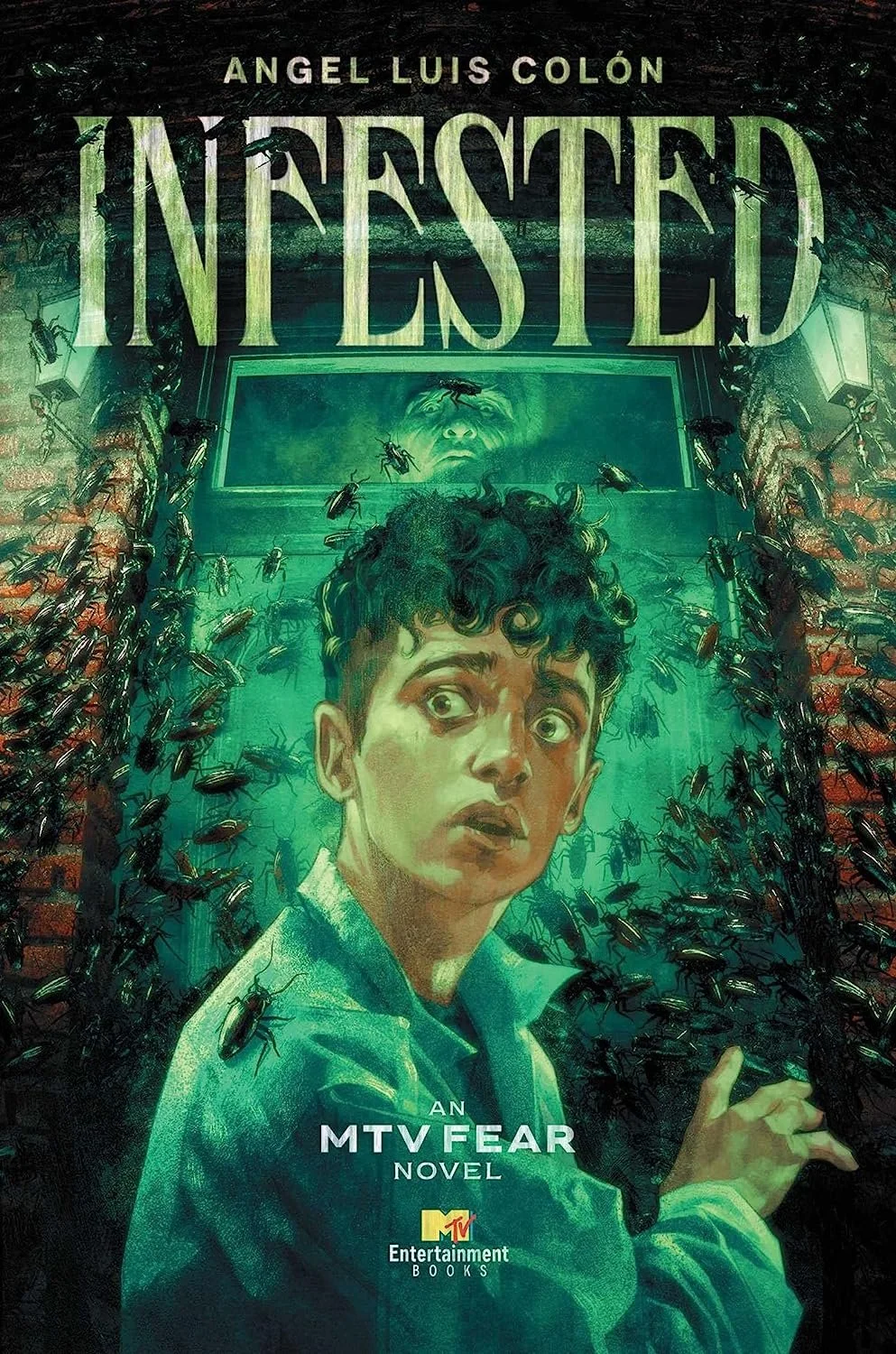
Review and Author Q & A: Infested by Angel Luis Colón

“I can’t remember a time I hated my mother and my stepfather more than the summer before my senior year.”

Anger boils in the opening of Angel Luis Colón’s young adult debut novel, Infested (out now by MTV Books). Manny Rivera is seething over his parents’ decision to uproot him and his baby sister, Grace, from San Antonio to the Bronx. He’s now without friends, without a car, and to make matters worse: he’s been tasked with helping out in his family’s new home—a luxury condo building his stepfather, Al, is managing. Al’s job is to get the Blackrock Glen ready for tenants—and there’s a tight deadline.

One small light in this new gloomy chapter for Manny is a budding friendship with Sasha, an outspoken Afro-Latina who is protesting Blackrock Glen even as she and her family plan to move there. And he meets Mr. Mueller, an exterminator hired to rid the building of roaches, and who seems to take a liking to Manny. Mr. Mueller looks to be in his seventies, with a messy mop of hair and sunken eyes.

As Manny starts to address issues in different apartments throughout Blackrock Glen, he finds cockroaches—“creepy, crawly, little shit-born roaches with twitching antennae and creepy legs.” Then comes the nightmares, followed by more incidents with the insects. And even more sinister, Manny notices that contractors hired to do jobs in the new building are missing.

After some digging, Manny and Sasha come to the paralyzing realization that the Mr. Mueller they see around the neighborhood is no longer alive. He actually died decades ago in a fire, in the same exact location where Manny’s new building is. And it was one that Mr. Mueller himself set.

Colón’s graphic body horror descriptions paired with commentary on themes like gentrification, race and class, make Infested not only a deeply entertaining story, but an important one. Readers new to horror may also get a thrill out of the major ick factor moments in the book. And threaded throughout expertly is food for thought about the navigation of Puerto Rican identity, and one’s place in Latinx culture.

Will Manny be able to save his family from an unhinged ghost determined to repeat history?

On behalf of Latinx in Publishing, I spoke with Colón about the inspiration behind Infested, the horror subgenre of body horror, and more.

Colón’s graphic body horror descriptions paired with commentary on themes like gentrification, race and class, make “Infested” not only a deeply entertaining story, but an important one.

This interview has been edited for clarity and brevity.

Amaris Castillo (AC): Congratulations on Infested! This is your YA debut novel. What inspired you to tell this story?

Angel Luis Colón (ALC): Initially I had been thinking about YA for a little while. I was coming from the adult crime fiction scene, and I wasn’t getting a lot of fulfillment out of it. I was very hesitant to write about my experience as a Puerto Rican from New York in that space, because of a lot of the negative stigmas that are perpetuated about Puerto Ricans—especially in crime fiction. You see TV, you know, all those things.

So I thought about: How do I write about these things I want to write about, in a different space that maybe is a little safer—that’ll let me explore things? My agent came to me with the news that MTV Books was coming back, and they were looking for ideas. We were having beers, and something just kind of struck me as an idea I wanted to look into. I pitched it to him, and then we pitched it to MTV, and it kind of blew up from there.

At first, it was like an interesting idea, right? But I think YA lets you explore things a little more allegorically. You can kind of go a little crazier. When that clicked, I was like, well, wait a second. There’s a lot of things we can talk about the Puerto Rican experience, at least in New York, and also bridge my upbringing in with it. As most Nuyoricans will know, you’re blanquito growing up. There’s a level of privilege that comes with that. There’s a level of issues that come with it, as well. But I decided I wanted to write a story about that point a white Latino has where you got to decide: Are you going to embrace the privilege? Or are you going to think about your place within your culture, and what role you can play to help it?

AC: Your main character, Manny, starts off feeling like he hates his mother and stepfather for moving their family from Texas to the Bronx, in the summer before his senior year. At first I chalked this up to teen angst, but there are other dynamics at play when it comes to his relationship with his parents. What message were you hoping to send by highlighting this tension between a child and his parents?

ALC: I found an opportunity with that because I thought about my own tensions with my family coming up. It goes back to what it is to be Nuyorican, Puerto Rican. On paper, however you would describe it, I guess I’m third-generation American. Being Puerto Rican makes it funny to describe it like that, right? Because we were made American on paper, and whatever that means, too, but I digress.

But there are very stark differences between generations. And I realized a lot of my own angst came from how much more Americanized I was from my mother, versus how much more Americanized she was from her mother. You think about all these milestones we look at culturally. And, like you said, a senior in high school is so important, right? But really, is it? It’s important because we’ve been told it’s important. And there are reasons for it being important, like college and all that. But to a teen’s mind, they look at it as important because they’ve been told all of their lives. When I thought about all that (older) generation, my mom never cared. That wasn’t something that she had to care about. For her and her generation, senior (year) in high school was the end. There was no college. There was no thought beyond that. You went straight to work. So I wanted to play around with that.

I thought hard about how I had the privilege of being like, ‘Well, this is such a pivotal time in my life. I’m going to have college.’ And the people older than me are like, ‘What are you talking about? You gotta live.’ It helped me with that balance between how his mother and stepfather were just kind of like ‘We’re moving. This is an opportunity. Why are you so upset?’ They don’t grasp it, because, to them, they’re doing the right thing based on where they’re coming. In their minds, providing for family and working are the two most important things. But to Manny, he has had the privilege to be able to have a little more long-term thinking. So for him, he’s like, ‘Well, I hadn’t started yet. What are you talking about?’

AC: Your book definitely has the ick factor by way of body horror. There are moments that had me looking around to make sure there are no roaches near me. What was it like for you to bring this subgenre of horror to a younger audience?

ALC: That was really important to me. I actually thought about that a lot, and I wrote about it recently for CrimeReads. My first horror movie was the 80s remake of The Thing. I was only five years old, and my uncles thought it would be hysterical to show it to us—me and my three cousins. I ran out of the room. I was mortified and just completely traumatized.

I was not a fan of horror until maybe five or six years later, and we saw this movie called The Gate. It was awful, but it made me realize that you can find different types of horror. And then I would go back to the crazier stuff but I realized, when you’re young, that stuff is very scary. I look at my own kids and see how they react to certain things, and I’m like, ‘Oh, OK.’

I wanted to think about it that way—what can I write for somebody who is kind of like a gateway? Isn’t too extreme, but isn’t too nice either. Something that one reader out there will be like, ‘I want to check out some other stuff.’ I got a kick out of that.

AC: When Manny meets Mr. Mueller, the building’s exterminator seems friendly. Manny and his new friend, Sasha, later discovers that Mr. Mueller is a specter who espouses certain beliefs about their Bronx neighborhood. Can you share how you landed on this paranormal aspect while writing the novel?

ALC: Initially I wasn’t going to, but then I felt like that was a little too real. I grew up in the Bronx. I was actually born in Texas—where I pulled the Texas thing for Manny from—but I was only there for a couple years. My parents divorced, and I kind of grew up solo and I was raised by my grandparents and different men throughout my life. A lot of them served as mentors, but also were very entrenched in their way of thinking. So I pulled a lot of that into Mr. Mueller—it’s having this person that you can bond with that is problematic. That was very common when I was growing up in the Bronx, because you have this very weird melting pot of folks. And a lot of the older folks would have incredibly antiquated views, and they were very stuck in their ways.

There was one guy I grew up with, the father of my mother’s best friend. He was an incredibly racist old man. It was a very complicated relationship with him, because he had a charm about him. You can get along with him and he would make you laugh, but then he would say something that was just insane. It was easy for him. It wasn't even awkward. So I wanted to channel into how that hate becomes like an infestation. It’s something that you can’t just scrub out.

At first, we were gonna keep Mueller pretty grounded, but I felt like that was just way too real. And I really wanted to go into the paranormal things. So we decided: How do you create a character that’s allegorical to that, and is kind of like this physical manifestation of that grime that grows on people’s souls? It clicked: We’ll make him make him a ghost, and we can loop in Bronx history into that.

AC: In Infested there’s an added storyline about gentrification, class, and this question of who belongs where. Can you talk about your decision to anchor your book in these themes?

ALC: If you’re not from the Bronx, there’s always a stigma around the Bronx. Growing up, when people would meet me, they’d be like ‘You’re tough. You’ve seen people explode or die.’ Lots of nonsense. And that all stems out of the 70s, when the Bronx was on fire and you had the influx of lots of Latino and Black people that were leaving the island when Harlem was being gentrified, actually. I grew up with that stigma, and at the tail end of the worst times that the Bronx had.

Yeah, I saw some things, but there’s still humanity to the neighborhood. There’s still a very proud culture to it. I think the Bronx had this distinction of having that stigma working for them, in a way that gentrifiers avoided the Bronx. So when Brooklyn was really getting built up, people just ignored the Bronx. Then that changed, and when I’d visit I started seeing new buildings, things were shifting, and rents were going up. And for a while, I kind of deluded myself into thinking ‘Well, we’ll never let this happen. We’re too in here. We’re too strong.’ You can tell yourself that, but money at the end of the day is always going to beat you if you don’t have it to fight back. And I began to see real changes in the neighborhoods I grew up around.

At first you’re like, ‘A new building can’t be a bad thing. New businesses can’t be a bad thing, right?’ But you begin to realize these businesses aren’t meant for the people there. And that’s where the real problem starts. I thought a lot about that, and realizing that the Bronx is changing now. And it’s a bummer to me. Growing up in the neighborhood I grew up in, you don’t want to see what made that neighborhood so special to you change. I always felt like I was a very fortunate person growing up in the Bronx. I was able to be around Latino people, I was able to be around Black folk, Asian folk. It was really cool. And it’s such a bummer to think about that going away. I wanted to really get into that, and I thought it would be an interesting thing to have the main character of the story be part of the problem. Maybe not by choice, but he’s there and he’s living in this building.

AC: What are you hoping young readers take away from Infested?

ALC: When I really got into things, I realized I was putting a book together that I wanted to read at that age. I wanted to write a book for a blanquito who is out there, maybe in the same situation I was at that age and other white Latinos are—where you’re at that impasse. You can embrace your privilege and be the token of a white group, and continue on some weird path. Or you can sit back and begin to think about your culture and what you can do for it, and how you can be a better ally to the Black folks in the Latine culture. They’re consistently written-off people who are part of you as well. And that first step to decolonization. I really was invested in that.

I didn’t want to be another Latin writer who was just playing around in the marginalized space to make white people feel comfortable. That was a big concern of mine, especially thinking about my own privileges. Because, very often, white Latine writers, white Latine performers, and other creators are used, to be tokens—to make that check, where it’s like, ‘We got the representation.’ So I very much wanted to call that out. And I wanted the book to be about colorism and gentrification because of that.

I wanted to push back against those two pieces. The two pieces that I always see are either using us for our pain, or using us as a filler to provide safe stories. It’s tough to navigate, and you never know if you get it quite right. That’s the hard part about it, because it’s complex. But my hope is that readers take that, and that readers like that. I want everyone to be able to see maybe a little of themselves in the story through Sasha, or through someone else like Manny. And see the things that they grew up around, at least represented somehow.


Angel Luis Colón is a Derringer Award and Anthony Award-nominated author writer of HELL CHOSE ME, the Blacky Jaguar novella series, NO HAPPY ENDINGS, and the short story collection MEAT CITY ON FIRE AND OTHER ASSORTED DEBACLES. His fiction has appeared in multiple web and print publications including Thuglit, Literary Orphans, and Great Jones Street. His debut YA novel, INFESTED, comes out in July 2023. Keep up with him on Twitter via @GoshDarnMyLife.

Amaris Castillo is a journalist, writer, and the creator of Bodega Stories, a series featuring real stories from the corner store. Her writing has appeared in La Galería Magazine, Aster(ix) Journal, Spanglish Voces, PALABRITAS, Dominican Moms Be Like… (part of the Dominican Writers Association’s #DWACuenticos chapbook series), and most recently Quislaona: A Dominican Fantasy Anthology and Sana, Sana: Latinx Pain and Radical Visions for Healing and Justice. Her short story, “El Don,” was a prize finalist for the 2022 Elizabeth Nunez Caribbean-American Writers’ Prize by the Brooklyn Caribbean Literary Festival. She is a proud member of Latinx in Publishing’s Writers Mentorship Class of 2023 and lives in Florida with her family and dog, Brooklyn.

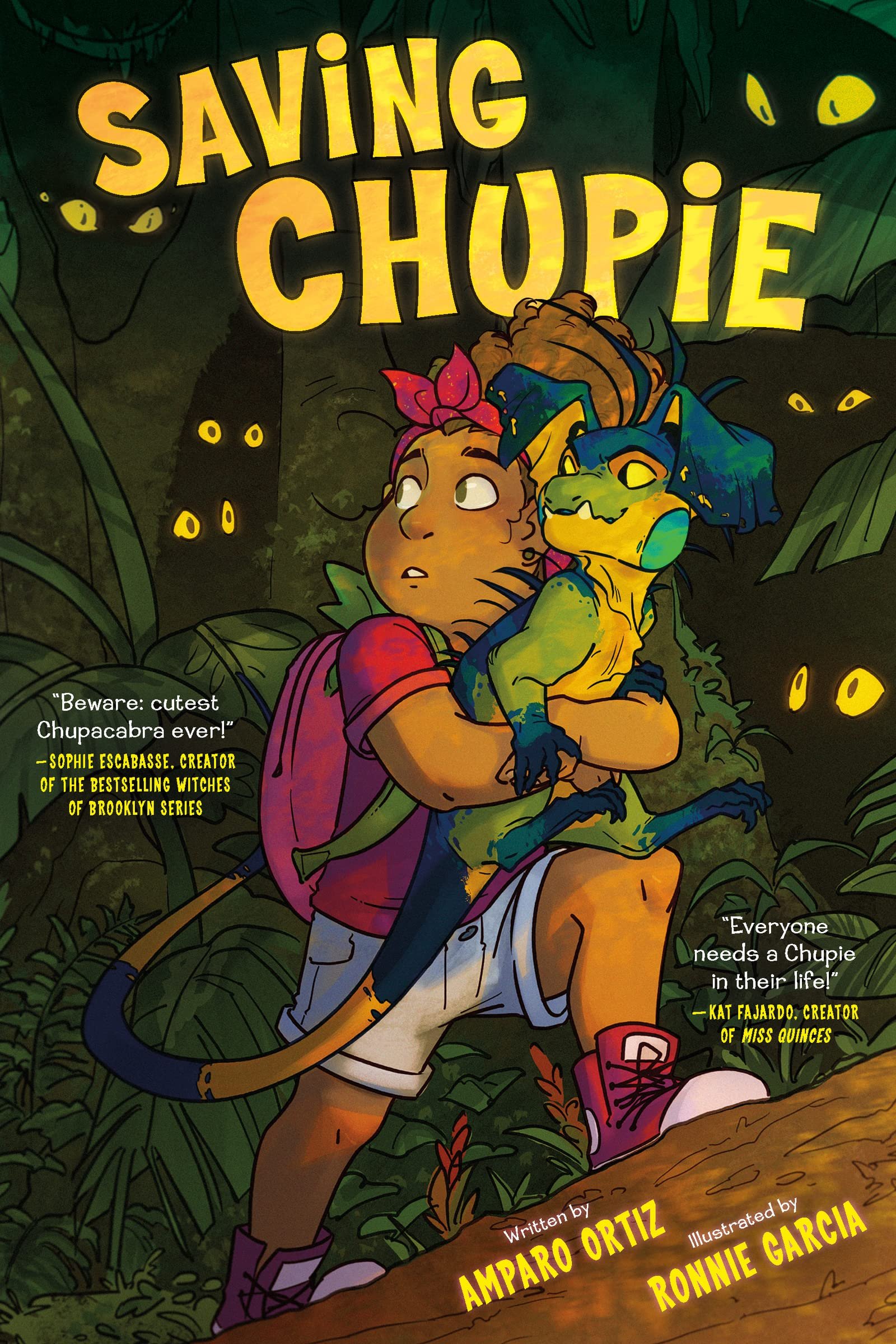
Review and Author Q & A: Saving Chupie by Amparo Ortiz and Illustrated by Ronnie Garcia

Saving Chupie opens to a beaming Violeta Rubio, who has just landed in Puerto Rico. She is thrilled to be on the island for the first time ever. And she’s here with her parents on a mission: to help her Abuelita get resettled.

Hurricane María—the deadly Category 5 hurricane that devastated the island in 2017—had forced Violeta’s grandmother to leave behind her apartment and beloved restaurant for Violeta’s home in Florida.

“I’m gonna help Abuelita get everything back to normal so she can stay for good,” Violeta narrates. “She’ll never ever be sad again.”

There’s just one problem. Violeta’s parents and grandmother won’t let her help with anything, and now she’s bored here without friends. But that quickly changes when she meets Diego, the son of a butcher who used to sell meat to Abuelita for her restaurant. Violeta learns then of rumors that the chupacabra is to blame for recent attacks on animals belonging to a local meat supplier.

The belief in the creature’s existence is laughable to Violeta. “I won’t believe until I see one with my own eyes,” she thinks to herself. When Diego and his best friend, Lorena, ask for help in capturing the chupacabra, Violeta sees a chance to develop true friendships on the island. So while searching for the creature alone, Violeta is shocked to stumble into one. And she discovers that he’s not the monstrous beast others have painted him to be. This chupacabra is adorable, even. She names him Chupie.

Now Violeta finds herself in a web of secrecy as she tries to keep Chupie out of sight. And soon there’s a new threat she and her friends must navigate—protecting the creature from an international network of smugglers and monster hunters.

Author Amparo Ortiz and illustrator Ronnie Garcia have brought readers an irresistible middle grade graphic novel filled with heart, adventure, and friendship. It also does not shy away from the harsh realities that Puerto Ricans had to face in the aftermath of Hurricane María. Garcia’s illustrations, paired with Amparo’s text, breathe vibrancy and warmth to this story. The Eisner Award-winning artist also did a wonderful job in reimagining a familiar legendary creature in Puerto Rico’s folklore.

Author Amparo Ortiz and illustrator Ronnie Garcia have brought readers an irresistible middle grade graphic novel filled with heart, adventure, and friendship.

On behalf of Latinx in Publishing, I spoke with Ortiz about the chupacabra, what it was like to work on this unique story with Garcia, and more.

This interview has been edited for clarity and brevity.

Amaris Castillo (AC): Congratulations on Saving Chupie! This is your first middle grade graphic novel, and I read that you auditioned for the opportunity. What attracted you to this project?

Amparo Ortiz (AO): Indeed it is my very first middle grade, and my very first full-length graphic novel by myself. I’m very much used to writing short story comics, so this was a challenge and also an item on my bucket list—which is why I was initially attracted to the idea of auditioning. But I was heavily intimidated with the idea as well. And that’s precisely my formula for why I should do things in this industry: Does it challenge me? Is it intimidating? Good, let’s go.

AC: Your main character, Violeta, is visiting Puerto Rico for the first time with her family to help Abuelita revive her restaurant. We learn almost immediately that this takes place after Hurricane María. Why was it important for you to set the story during this period of recovery?

AO: When the story pitch came to me, it was already set during this period, and in a town that feels like my hometown because it’s my neighbor. I felt like this was a piece of home that I, of course, could have left someone else to write, but I just felt called to it because it was familiar. It was real. It was something that didn’t gloss over those post-María lifestyles, mindsets, and harsh realities. I felt like I could tackle that in a way that still honored what makes us beautiful, which is yes, our resilience.

But I think that’s kind of a cliche—saying Puerto Ricans are about resilience, or anyone in the Caribbean is about resilience. That sense of community stems from always being there for each other, but within these cultures and these separate countries, there are realities that are not shared. Seeing it from the perspective of someone who still lives here and is aware of things that maybe someone who is either diaspora, or who has never been to Puerto Rico don’t see as closely, is an added special touch that I could bring forth.

AC: I remember when chupacabras were all over the news. There were reported sightings in Puerto Rico and other countries, and there was some fear—as well as speculation. In Saving Chupie, the beast that Violeta finds does not appear to be the dangerous threat her friends think it is. What was it like to reimagine the chupacabra for this story?

AO: It was such a blast, honestly, because I have always been a horror fan, but through film and television. So when it came time to develop what Chupie was like, and the lore behind what Chupie is or what Chupie could be, I felt like this was a twist on something that I grew up actually hearing about. I was born in the 80s, and in the 90s we had a resurgence of the myth or the scares in Puerto Rico. The mayor of my hometown constantly went on hunting trips to find the chupacabra. So I felt like it was a nod to my past and something that I grew up with, but that I never really took seriously, not even as a child.

I do relate to Violeta when she is just super anti-believing this is real. Having a child question fantasy is something that I also had no experience with, in the fiction that I was consuming, because children are often quicker to believe that fantastical things are real. And so she was like, ‘Well, that’s ridiculous. Why would there be a monstrous creature roaming around town? It makes no sense. Y’all are just weird.’ It’s something that stems from the fact that she is not an islander herself. Most islanders in the book—and in reality—would be a little bit more partial to honoring whatever lore they’ve grown up listening to, or they’ve actually encountered in some way. And in this case, she simply is just straight out straddling that line between ‘Well, I grew up in Florida and I feel like gators are our worst nightmares there. There’s no monster here.’

AC: There’s another storyline here about the adults in Violeta’s life, particularly her Abuela, not wanting to accept her help. What message were you hoping to send by highlighting this tension?

AO: This is twofold, because as Latinas we live in what is considered a patriarchal society, a lot of which is evidenced through our daily conversations, how we live our lives, and the consequences of our choices. When it comes to how Abuelita reacts to accepting help, she is saying ‘no’ out of survival. She has to basically carry weight on her shoulders that isn’t hers, but she accepts it as hers simply because she knows she is lightening the load for others. And that is a very Latina thing to do.

It’s generational, because I feel like now you would speak to grandchildren who maybe don’t have any weight on their shoulders. They might have other loads.. They’re trying to figure out how to live, how to provide, how to survive. With an Abuelita and a Violeta, we have two very different people who approach life differently, but what they share is a love for each other and a love for their community. That’s something that is going to propel both of them into making compromises.

One of the main things I want readers to take away from Saving Chupie—whether they are Violeta’s age or Abuelita’s age—is for them to look within, and see where am I burdening myself? Where am I choosing to lighten someone else’s load, but I’m actually just making life harder for myself? And not honoring rest, not honoring compassion, not honoring mercy for what I really want to be.

AC: The illustrations by artist Ronnie Garcia are vivid and filled with so much expressiveness. What did you think of the job they did in helping to tell this story visually?

AO: I cannot properly explain how I felt when I first opened an email from my editor, Carolina Ortiz, with Ronnie’s art. For the audition, I actually saw Ronnie’s art first before I ever saw anything regarding the script because Ronnie had been hired first. Their designs were the ones that I saw as inspiration for the rest of the work. When I saw the initial sketches, I felt like I knew where it was going in terms of the humor, the heart. I knew what kind of person Violeta was. I knew what kind of creature Chupie was.

And then when I saw my first pages that I specifically scripted with Ronnie’s art, I literally lost all sense of control and I kind of squealed. I can’t remember the noise I made, but it’s definitely not a human noise. I remember emailing everyone back, like ‘I am not alive anymore. This is not real life.’ Because it’s the first time that I’d ever seen my art illustrated, and in that way. It was a full-length work, and everything was already sketched. I DM Ronnie all the time, like ‘You are not even real to me.’

AC: What are you hoping readers take away from Saving Chupie?

AO: The main goal is for them to truly enjoy a story set somewhere that maybe they’re not too familiar with, and that they can appreciate the high jinks, humor and heart through someone who is just as unhinged as I was as a child, but who is also as loving, and caring, and selfless as I want to be every single day. Violeta is mostly what I was and who I wish to be, or continue to be. Maybe that will capture the attention of the reader—this sense of adventure and magic in our world. At the same time, I want them to see someone who truly does put others first, but never gives up on her values and what she stands for.


Amparo Ortiz was born in San Juan, Puerto Rico, and currently lives on the island’s northeastern coast. While Blazewrath Games is her debut novel, Saving Chupie is her first book for middle grade readers. Her short story comic, “What Remains in the Dark,” appears in the Eisner Award-winning anthology Puerto Rico Strong. She holds a master of arts in English and a Bachelor of Arts in psychology from the University of Puerto Rico’s Río Piedras campus. When she’s not teaching ESL to her college students, she’s streaming K-pop music videos, vlogging for her eponymous YouTube channel, and writing about Latinx characters in worlds both contemporary and fantastical. Follow her shenanigans at www.amparoortiz.com.

Eisner Award-winning artist Ronnie Garcia is a queer Puerto Rican illustrator with experience in comics and visual development. With a range of storytelling experience from middle grade to young adult, their signature talent involves designing creatures of the tooth variety. They have illustrated for several independent anthologies and books, and currently teach young artists in their community. When they’re not drawing pictures or working with young artists, they can be found huddled in a blanket fort working on puzzles and eating fruit snacks.

Amaris Castillo is an award-winning journalist, writer, and the creator of Bodega Stories, a series featuring real stories from the corner store. Her writing has appeared in La Galería Magazine, Aster(ix) Journal, Spanglish Voces, PALABRITAS, Dominican Moms Be Like… (part of the Dominican Writers Association’s #DWACuenticos chapbook series), and most recently Quislaona: A Dominican Fantasy Anthology and Sana, Sana: Latinx Pain and Radical Visions for Healing and Justice. Her short story, “El Don,” was a prize finalist for the 2022 Elizabeth Nunez Caribbean-American Writers’ Prize by the Brooklyn Caribbean Literary Festival. She is a proud member of Latinx in Publishing’s Writers Mentorship Class of 2023 and lives in Florida with her family and dog, Brooklyn.

Review and Author Q & A: Barely Floating by Lilliam Rivera

Barely Floating begins with a splash—both literally and figuratively. Natalia De La Cruz Rivera y Santiago (also known as Nat) dares her brother’s friend, Beto, to a race at her local Inglewood pool. The 12-year-old proud gorda is certain that she can out-swim him, and she’s willing to bet money on it. Ten bucks, to be exact.

“From here to the full length of the pool,” Nat tells Beto as a crowd grows around them. “C’mon. What are you afraid of?”

In this forthcoming middle grade novel, the image of a self-assured Latina girl in Los Angeles came early to Pura Belpré Honor Award-winning author Lilliam Rivera. “I love this character,” Rivera said. “She is aware of her power, and that is because she grew up in this kind of environment where they really are about teaching that.”

It’s at this same pool where Nat bet Beto that she learns about synchronized swimming. When a local team, called the L.A. Mermaids, does a demonstration in the water, Nat immediately falls in love. But her activist mom and professor dad feel the sport is too body-conscious. Their no-for-now does not stop Nat, who devises a plan to join the team anyway. She enlists the help of her older cousin, Sheila, and soon dives into the world of synchronized swimming all while telling herself she’ll be able to convince her parents to let her stick with it.

Out on August 29, 2023, by Kokila Books, Barely Floating is a heartwarming and hilarious middle grade novel about a girl with an unforgettably fierce spirit who goes after what she wants. It’s a bumpy ride, but filled with moments both tender and funny. For her book, Rivera drew from personal experience as a synchronized swimming mom to expertly depict the world of synchronized swimming. Readers are also drawn close into issues related to class and the different tensions between girls and their mothers. There’s also an important lesson here in balance, on how sometimes we can’t do it all alone, instead we can seek community in helping us juggle what we need, to get the work done.

“Barely Floating” is a heartwarming and hilarious middle grade novel about a girl with an unforgettably fierce spirit who goes after what she wants. It’s a bumpy ride, but filled with moments both tender and funny.

On behalf of Latinx in Publishing, I spoke with Rivera about her new book, Barely Floating. She shared the inspiration behind the middle grade novel, what it was like to anchor Nat’s story in this sport, and more.

This interview has been edited for clarity and brevity.

Amaris Castillo (AC): What inspired you to write this book?

Lilliam Rivera (LR): Barely Floating is inspired by my life as a synchronized swimming mom. My oldest daughter is in college now, but when she was about seven years old we would take her to the local public pool. She was just learning how to swim and (one day) a Latina coach there was like, ‘Do you wanna learn how to dance in the water?’ She wanted to, so then I looked for a team out here in LA that was inclusive. I found one team that’s in the city proper. It’s Black-owned, and she joined that team. I lived in that world with her for a few years, and this was before I even started writing books. But I would be known as the mother who would bring a laptop to the competitions because I would just spend a lot of time writing and observing that world.

It’s also inspired by young children; people that I know who fall in love with something and maybe they’re unable to voice why they love it, or maybe their parents don’t think it’s going to work out. Kids start and stop a lot of things at that age. I wanted to write about this character, Nat, who is very much grounded in what she believes in and lives in a family that’s so outspoken, politically active, and about community. And yet, they still have their own blind side when it comes to their own children. I really wanted to explore that aspect of growing up in that kind of environment.

AC: One thing I loved about your book is the confidence and grit Natalia has. She’s out here daring other kids into swim bets to make money. She’s also a proud gorda and knows she’s beautiful. What was it like crafting this character who, from the first page, seems so empowered?

LR: Nat came to me very early on. The first image was really that first chapter of her out-swimming somebody. She was ready. She knew she could beat whoever. I love this character. She is aware of her power, and that is because she grew up in this kind of environment where they really are about teaching that. I love this family, but I also love that they still fall short, even when they’re doing their very best.

Nat is very business-oriented. She is ready to get paid. To her, it’s like ‘I can do this. No one can tell me not to.’ That’s why she went on to join this team, and to negotiate who she could convince to help her in that: her cousin and her brother, and all the people involved to help her achieve her dream. I feel that is a reflection of her mother, who is also that person who is community-oriented. She’s (Natalia) learned that. That’s why she’s so fully formed in that way.

AC: From the moment Natalia falls in love with synchronized swimming and secretly tries out for a local team, much of her life is turned upside down. The L.A. Mermaids is Black-owned and diverse, but Natalia laters learns that as a whole the sport is white-dominated. Can you talk about your decision to anchor your book in this sport, and what Natalia’s story says about kids of color who may be in a similar situation?

LR: When we were going to these teams, I was really aware of the discrepancy between those who come from affluent neighborhoods and others who don’t. Being on a team itself is a lot of money, and even Nat notices. She sees all the fees. And this is the key: As a parent or guardian, you have to really figure out ways to offset these costs. It’s almost another job, trying to find ways of navigating these kinds of systems that are not meant to be inclusive. With Nat, she just tries. To me it’s all about a community. It’s the community that could try to figure out a way of making things happen. Nat relies on her cousin and her brother, but she’s also relying on her best friend, and her teammates, as well: ‘How can I go to this competition if I don’t have a ride?’ These are aspects of my own experience when I had my daughter involved (in artistic swimming) because it was a huge commitment. But I leaned on a lot of people.

With young people, you’re not doing this alone. It’s like, ‘How can I go about accomplishing a dream or whatever it is I want to do? If I want to do art, maybe someone I know is an artist. Maybe I could see them.’ Facilitating those kinds of conversations is such a white privilege thing. They say, ‘An overnight success,’ it’s not when you realize they knew somebody. They were able to get this job somehow, because they had a connection to someone. And that’s a skill set that we all have to do. It’s like, who do you know who could help you? I think that’s a goal for our community. Because that’s all we ever do, is help each other. That’s how we survive. Even young people can do that. That is the one thing that I would love readers to take away, that community doesn’t start with just adults. A community starts with your schoolmates, with your friends, with those around you. They can help you problem-solve in a way that maybe you didn’t think about.

AC: There’s a tension throughout your book between Natalia and her activist mom. Natalia is keenly aware of all the things her mom is against, which include synchronized swimming and the beauty standards in fashion magazines. Natalia has different views. What message were you hoping to send by highlighting this tension between a child and her parent?

LR: Relationships are all so complicated. It’s not just black and white. We’re really living in a kind of gray. I wanted that relationship between Nat and her mom to reflect that—in the sense that they both needed to grow. Their relationship needed to shift.

There’s this moment when you’re in that age group, and you’re trying to really place your feet firmly on the ground in the world. You want to be seen and heard as the person that you are for that moment. And all that can change, but for this moment, look at me. Sometimes as parents, we overlook that because we’re busy just trying to protect our children at all costs, and that never changes as they grow older. But I really wanted this idea of: It’s not yes, or no, or right, or wrong. It’s more like, this is where I am. This is where I am standing, and can you meet me in this spot? Can we have a conversation about where we go from here? What path do we take from here that we can take together? And I love that, that forces her parents to just stop and see that their biases are really clouding their vision of their daughter, that their wanting to protect her is messing with her creativity. You could look into the history of things and maybe find a way of enjoying it, or reclaiming it as your own.

AC: What are you hoping readers take away from Barely Floating?

LR: First, I hope that they fall in love with Nat because I love her. And not only Nat, but even her cousin, and her (best friend) Joanne and her teammates and their group chats. I hope that they enjoy the humor because I think there’s a lot of really funny moments. Nat has a very unique sense of humor and is very honest when it comes to what she says and does.

And I hope that they get to enter a world that maybe not that many people know about. Synchronized swimming is called artistic swimming now. It’s such a hard overall sport. It’s amazing the stuff that they do underwater—doing flips and kicks. I’m just always in awe of anyone who dedicates time and effort to do a sport. This book is part of that conversation, of all these kinds of great sport books. And love that it’s based here in Los Angeles and these characters are very relatable. It’s a really fun and funny, enjoyable read—even if you don’t like swimming.


Lilliam Rivera is an award-winning author. Her many books include young adult novels The Education of Margot Sanchez, Dealing in Dreams, Never Look Back (a Pura Belpré Honor book), as well as the Goldie Vance series for middle grade readers and the forthcoming, stand-alone middle grade book Barely Floating. Her latest novels We Light Up the Sky and Unearthed: A Jessica Cruz Story were named “Best Books of 2021” by Kirkus Review and School Library Journal.

The Pushcart Prize winner has also received fellowships and grants from PEN America, the Elizabeth George Foundation, Clarion Workshop, and the Speculative Literature Foundation. Her writing has appeared in the Washington Post, the New York Times, and Elle, among others.A Bronx, New York native, Lilliam currently lives in Los Angeles.

Amaris Castillo is an award-winning journalist, writer, and the creator of Bodega Stories, a series featuring real stories from the corner store. Her writing has appeared in La Galería Magazine, Aster(ix) Journal, Spanglish Voces, PALABRITAS, Dominican Moms Be Like… (part of the Dominican Writers Association’s #DWACuenticos chapbook series), and most recently Quislaona: A Dominican Fantasy Anthology and Sana, Sana: Latinx Pain and Radical Visions for Healing and Justice. Her short story, “El Don,” was a prize finalist for the 2022 Elizabeth Nunez Caribbean-American Writers’ Prize by the Brooklyn Caribbean Literary Festival. She is a proud member of Latinx in Publishing’s Writers Mentorship Class of 2023 and lives in Florida with her family and dog, Brooklyn.

Matt Sedillo: His Book Tour in Italy and translated work

Matt Sedillo is a Chicano political poet, essayist, and activist, based in Los Angeles, who is also starting his own press called El Martillo Press. Sedillo recently had an international book tour in Italy, after his work was translated into Italian. In this interview, he tells Latinx In Publishing Communications Co-Director Ruddy Lopez about Vite derubate, Terra derubata, how this tour came about, and his experience having his work translated.

This interview has been edited for clarity and brevity.

Ruddy Lopez (RL): Tell me about your book tour in Italy and how it came about.

Matt Sedillo (MS): The book tour came through my publisher, Ensemble. They set up all the readings. When I say my publishers, it really was chiefly the effort of Edoardo Olmi, who was instrumental in the entire process. The trip included stops in Rome, Florence, Bitonto, Molfetta, Bari, Turin, Bologna, Venice, Varese, and finally Colleferro. It really was like several different trips all in one, each deserving its own careful retelling. I am still processing so much of what happened as this all was in the course of around three weeks.

I arrived in Rome two days early, planning to get over the jet lag. No such luck. Flamina Cruciani, a poet that David A. Romero and I are publishing, lives in Rome, so I figured it a good idea to meet up with her. Flamina is an incredible poet whose work has been celebrated all over the world. At dinner, we discussed the possibilities of readings in Colombia, the U.K. and what El Martillo would set up for her once she came stateside. On the day of the reading, I met Edoardo at the train station and we headed over to meet with Mateo, one of the owners of Ensemble Press, who had a box full of the books. It was an incredible feeling to open the box and see my translated work. I handed Mateo copies of El Martillo publications and we discussed a world of possibilities. That night I read at the famed Lettere Caffe with close to two dozen poets as the book made its debut. Many of these poets are noted on the national stage of Italy, as I am coming to understand. This was a great honor and I am still in the process of following up with the many doors and opportunities that appeared to have opened that night.

In Florence, I read at the University in a student-occupied center as part of a larger festival. While there I struck up a fascinating conversation with noted choreographer Cristina Rizo and we discussed her approach to dance and my approach to poetry and found some fascinating points of overlap and differences.

For the readings in Bitonto, Molfetta, and Bari, I spent three days living in an Antifa compound called Ex Secerma, meaning former barracks. The space was once a military barracks and now it was an anarchist co-op of some sort. The readings were set up by Edoardo, through our mutual friend Mark Lipman and their friend Pipo Marzulli, organizer of the poetry festival held there every other year. Pipo is a member of the Revolutionary Poet’s Brigade, an international organization founded by Hirschman, over a decade ago. Its proud legacy continues. Mark had invited me last year to Elba, where I first met Edoardo, alongside Anna Lombardo. They both loved my work so much that they committed to a translation and a publication.

In Turin, I met up with Mateo and David, the owners of Ensemble. I commented what a strange twist of fate as I was starting my own press with my friend David A. Romero. We had a great laugh about this. The festival itself was massive. It was such an honor to be there at the booth with the publisher and to see the size and scope of all the incredible writers that are housed by Ensemble. The translation branch of the press, Affluenti, has also published Dianne Suess. Meeting the Italian book-buying public all happened so fast. We sold quite a few books and we met the public head-on as literally thousands of people were at the event. There was a great deal of interest in the American political landscape. And I answered as best I could through Edoardo.

In Bologna, we took part in a festival of books put on by Seven Foxes, a bookstore that had a strong working relationship with Ensemble. The festival was held in a public park and my reading was followed with a Q & A. The audience was very curious about how I became so politically outspoken and what the dangers were in the U.S. of being as strident as I am. I answered to the best of my ability.

Venice was incredible, really truly one of the most surreal experiences for me. At this point in my life, I can say I have read at the University of Cambridge, at UNAM, at Casa De Las Americas, and now at an international poetry festival held in Venice, Italy. I have the great Anna Lombardo to thank for this. Anna has organized this festival for many years. Anna was a great friend and colleague to Jack Hirschman and working with Anna, for me, it really begins to cement my own legacy as a poet whose work is celebrated on an international level. At the festival, I ran into my old friend, the beat poet laureate of Hungary Gabor Gyukics, who translated and got my work published in three Hungarian literary journals; one of them right next to Sylvia Plath. What an honor that is. I also ran into my great friend Serena Piccoli, one of the best political poets I have ever met, and we talked about the doors that get closed when you speak out in an unapologetic fashion.

In Varese, I caught up with Gaetano and Maria Elena. While there I stayed in Maria Elena’s family home that was built in the 1300’s. That blew my mind. At the house there was a printing press, a work station and a painting studio. Maria Elena and Gaetano are maybe the most natural artists I have ever met. Also would you believe they got us incredible press for their event. In one paper I was compared to Amiri Baraka and Jack Hirschman. What an incredible honor to be compared to such legendary poets in print in another country.

Finally, I made my way to the last show in Colleferro. I was exhausted but it was a different kind of exhaustion. It was an exhaustion informed by a career and legacy-defining trip. It was a satisfied exhaustion. On the train it was announced there was a WWII unexploded bomb on the tracks and the train was delayed. We rushed onto the subway, and rushed from there to the bookstore. We were 15 minutes late to the reading and my head was pounding. The audience was mostly composed of radical teachers who asked the most insightful political questions of the entire trip. I did my best to answer the questions and that was that.

(RL): How did you feel seeing your poems translated into Italian for the first time?

MS: It was incredible to get a hold of the book for the first time. I really do feel as though my life is about to change in a big way. I feel as though all my work, over the years, is beginning to really pay off. I feel as though I am just getting started. To be honest, the biggest feeling I feel right now is relief. It is a confirmation of what those who believed in me have always said about me. I may not have the biggest fanbase but I do have an incredibly passionate one. I have felt pressure over the years to live up to what my biggest supporters have said about me. I have articles in print comparing me to Brecht and Dalton, and others comparing me to Ginsberg. That is a lot of pressure. It is a lot to live up to. I feel like this is a step in the right direction and more than anything, I feel relieved to finally be headed in the right direction.

(RL): Tell us more about the Turin International Book Fair and your experience participating in it.

MS: The Turin International Book Fair is the largest most important book fair in Italy. To have been an invited guest is the stuff dreams are made of. I really hope to do more things like this across the world. I have my eyes set on Guadalajara, Berlin, and Medellin.

(RL): What advice do you have for writers hoping to have their work translated?

MS: My advice to writers wanting to have their work translated, especially speaking to an audience based in the U.S., is first to reverse your thinking on what it means to write. Here in the U.S. we are constantly told that writing is about healing or therapy or something that edifies the author. Writing can be all those things. But if you want people to care about your work, write about things that matter to more people than just yourself. Write not as a matter of personal expression but as a public service. Do that often enough and you will gain international attention. Write about things that matter and write well. Seek international stages. Do those two things at the same time and it may just happen for you as well. Right now I have been translated into three languages and there is talk of a fourth and a fifth. This happened because of both my content and my skill. Work on both.


Matt Sedillo has been described as the "best political poet in America" as well as "the poet laureate of the struggle." Sedillo was the recipient of the 2017 Joe Hill Labor Poetry award, a panelist at the 2020 Texas book festival, a participant in the 2012 San Francisco International Poetry Festival, the 2022 Elba Poetry Festival, and the recipient of the 2022 Dante's Laurel.Sedillo has appeared on CSPAN and has been featured in the Los Angeles Times, Axios, the Associated Press, and La Jornada among other publications. Matt Sedillo is the author of Mowing Leaves of Grass (FlowerSong Press, 2019) and City on the Second Floor (FlowerSong Press, 2022) as well as Terra Derubate, Vite Derubata (Ensemble Press, 2023). His poetry has been translated and published in Spanish, Italian, and Hungarian. Sedillo is the current literary director of The Mexican Cultural Institute of Los Angeles.

Ruddy Lopez is an Executive Assistant and Editor at Community Literature Initiative and Communications Co-Director with Latinx in Publishing. She lives in Inglewood, California, and attended California State University, Long Beach, where she obtained a BA in English Literature and English Education. In her spare time, Ruddy enjoys reading, writing poetry, and exploring what her city has to offer.

Review and Author Q & A: Plátanos Are Love by Alyssa Reynoso Morris; Illustrated by Mariyah Rahman

I grew up eating platanos: mangú, tostones and maduros (or fritos as we like to call them in our household,) so you can imagine how excited I was when I learned of a children’s book dedicated to one of my first loves!

Plátanos Are Love by Alyssa Reynoso Morris is a beautiful homage to culture, history, traditions and family. The story starts with a young girl who goes produce shopping with her grandmother. This introduction sets the foundation for the journey in which the little girl takes the reader. As she learns from her grandmother how to cook plátanos, in a variety of ways, she also learns about the importance that they hold in her ancestral history. Ultimately, we find the young girl passing on the knowledge of what her grandmother has taught her, in the kitchen, to her little sister; giving us a full circle heartfelt moment.

The book is filled with wondrous attention to detail, starting with the beautiful bright illustrations by Mariyah Rahman. From the grandmothers hoop earrings, to the array of hairstyles on the characters, I felt seen. The Spanish interwoven throughout the story, welcomes us to a Spanglish filled world; one many of us can recognize. However, it’s the reader care that we see via a glossary, for those unfamiliar with the Spanish words, and the recipes for the wonderful dishes, mentioned throughout the book, that really brings the book together.

I had the opportunity to ask Alyssa Reynoso Morris a few questions about Plátanos Are Love. She spoke about the inspiration behind the book, the importance of knowing our history, what we can expect next from her and of course, how she prefers her plátanos.

“Plátanos Are Love” by Alyssa Reynoso Morris is a beautiful homage to culture, history, traditions and family.

Tiffany Gonzalez (TG): What or who inspired you to write this book? 

Alyssa Reynoso Morris (ARM): I wanted to be a writer since I was 7 years old because I grew up with my Abuela—the original storyteller. She had a second-grade education, but that didn’t stop her from telling the best stories that captivated EVERYONE’S attention. I remember looking up to her and wanting to be like her. I think she knew that because she would rope me into “helping” her tell her stories. These are some of my fondest memories as well as the time we spent in the kitchen together. My love of my Abuela, her stories, and the food we made together inspired Plátanos Are Love.

TG: Immediately, I was drawn in by the Spanish words and loved the strong presence that "Spanglish" had throughout the book. It reminded me of my upbringing and of my day to day, in all honesty. Was that always the intention or did that come later on in the process of bringing this book together? 

ARM: I love this question. The Spanglish was intentional. Growing up I spoke Spanish at home and English in school. Then as I got older my English proficiency outpaced my Spanish. I found myself speaking in Spanish and in Spanglish every chance I got to preserve the language. With time I learned to take pride in my Spanglish and my goal with my writing is for it to be as authentic as possible. When I started writing it I had sprinkled in Spanish and fortunately my editor asked me to lean into it more, so I did and I'm proud of what we created.

TG: The history of our ancestors played a very important role in the book. Can you speak on why this was important for you to highlight?

ARM: I'm a political science major and I'm obsessed with how our history affects our present. Growing up I learned about Trujillo and the Parsley Massacre but I didn't learn about slavery and colonization until I was in school. I think it's important for kids to learn where they come from. I think kids should know how resilient their ancestors were so they know they are also resilient and can do anything they set their mind to. 

TG: It's essential for kids to see books that reflect their cultures; that reflect who they are. The one book I read as a child that highlighted Dominican culture has stayed with me till this day. Will you be continuing this work with future projects? Can we expect other aspects of Dominican/Puerto Rican culture or even just latinidad highlighted? 

ARM: I love this question and the answer is YES you can expect more Latinidad to come in my future works. My Dominican and Puerto Rican culture and experiences are such huge parts of my identity and storytelling that I can't tell stories without incorporating it in. My second book The Bronx Is My Home is a love letter to the Bronx from the perspective of a Black Puertorican boy. There are references to Latiné heroes like Sonia Sotomayor and AOC. My third book is called Gloriana Presente: A First Day of School Book and it starts with Gloriana's Abuela soothes her first day of school nerves by telling her stories about their family home in la República Dominicana. Gloriana is uncertain about how to exist between her two homes, or how to make new friends between her two languages. This imaginative picture book celebrates the magic of existing in-between, and the transformative power of self-soothing to build confidence. I think immigrants and particularly the Latiné/x/o community will resonate with the text. 

TG: Okay, if you had to choose one: tostones, maduros or mangú? And why? 

ARM: Asking me to pick one is like asking me what my favorite book is. I just can't choose one because it really depends on my mood. When I want something sweet I go for maduros. When I want something crispy I go for tostones. Mangú is great when I want to feel full and am trying to be healthier as it's not fried. I also love mofongo, pastelon, and alcapurias but we needed to edit them out of the book because the manuscript was getting too long.


Alyssa Reynoso-Morris is a queer Afro-Latinx Dominican and Puerto Rican writer, wife, mother, and community organizer. During the day she is a chief of staff working with community members, nonprofit organizations, and government officials to make the world a better place. Then she puts her writer's hat on to craft heartfelt stories about home, family, food, and the fun places she has been. Alyssa was born and raised in the Bronx and currently lives in Philadelphia with her partner and daughter. Alyssa is honored to be a Musa with Las Musas Books which celebrates the diversity of voice, experience, and power of Latinx children's authors. She hopes you enjoy her stories. You can visit her website at alyssaauthor.com.

Mariyah Rahman was born and raised in Trinidad and Tobago. She spent her earliest years climbing trees, digging for fossils, and drawing on walls with crayons. Today she is an illustrator for children's books and entertainment but has still never found a fossil.

Tiffany Gonzalez is the Marketing Manager at Astra House and the Communications Co-Director for Latinx In Publishing. She previously worked in Production at HarperCollins Publishers. She has worked on the Publicity and Marketing campaign for Dreaming of You by Melissa Lozada-Oliva and on the Marketing campaigns for Becoming Abolitionists by Derecka Purnell, The Sex Lives of African Women by Nana Darkoa Sekiyamah and National Book Award Fiction Finalist The Town of Babylon by Alejandro Varela. She has earned her Bachelors and Master's degrees from Rutgers University - NB. She is Dominican-American and fluid in Spanish. She is a Publisher’s Weekly 2022 Star Watch Honoree. You can follow her on Instagram @wandering_tiff_ or visit her website at wanderingtiff.com